TRANSCRIPT:
“From this distant vantage point, the Earth might not seem of any particular interest. But for us, it’s different.
Look again at that dot. That’s here. That’s home. That’s us. On it everyone you love, everyone you know, everyone you ever heard of, every human being who ever was, lived out their lives. The aggregate of our joy and suffering, thousands of confident religions, ideologies, and economic doctrines, every hunter and forager, every hero and coward, every creator and destroyer of civilization, every king and peasant, every young couple in love, every mother and father, hopeful child, inventor and explorer, every teacher of morals, every corrupt politician, every “superstar,” every “supreme leader,” every saint and sinner in the history of our species lived there – on a mote of dust suspended in a sunbeam.
The Earth is a very small stage in a vast cosmic arena. Think of the rivers of blood spilled by all those generals and emperors, so that, in glory and triumph, they could become the momentary masters of a fraction of a dot. Think of the endless cruelties visited by the inhabitants of one corner of this pixel on the scarcely distinguishable inhabitants of some other corner, how frequent their misunderstandings, how eager they are to kill one another, how fervent their hatreds. Our posturings, our imagined self-importance, the delusion that we have some privileged position in the Universe, are challenged by this point of pale light.
Our planet is a lonely speck in the great enveloping cosmic dark. In our obscurity, in all this vastness, there is no hint that help will come from elsewhere to save us from ourselves. The Earth is the only world known so far to harbor life. There is nowhere else, at least in the near future, to which our species could migrate. Visit yes. Settle, not yet.
Like it or not, for the moment the Earth is where we make our stand. It has been said that astronomy is a humbling and character building experience. There is perhaps no better demonstration of the folly of human conceits than this distant image of our tiny world. To me, it underscores our responsibility to deal more kindly with one another, and to preserve and cherish the pale blue dot, the only home we’ve ever known.”
An interview with Australian philosopher and professor David Chalmers discussing his theory of consciousness, the hard problem, and the explanatory gap.
Chalmers also has a wonderful online collection of academic papers, philosophical essays, and scientific articles over at Consc.net/online: a incredible resource for anyone interested in cognitive psychology, neuroscience, artificial intelligence, or philosophy of mind.
I have also written about my personal thoughts on this subject in some of my articles. In particular I recommend:
1. The Hard Problem Of Consciousness: Is Science In Need Of Another Cognitive Revolution?
2. The Epistemic Gap, Psychology, and The Scientific Method.
3. Thoughts On The Nature of Reality, Experience and Meditation

-
“Alex Grey (born November 29, 1953) is an American artist specializing in spiritual and psychedelic art (or visionary art) that is sometimes associated with the New Age movement. Grey is a Vajrayana practitioner. His body of work spans a variety of forms including performance art, process art, installation art, sculpture, visionary art, and painting. Grey is a member of the Integral Institute. He is also on the board of advisers for the Center for Cognitive Liberty and Ethics, and is the Chair of Wisdom University’s Sacred Art Department. He and his wife Allyson Grey are the co-founders of the Chapel of Sacred Mirrors, a non-profit institution supporting Visionary Culture in New York City.”

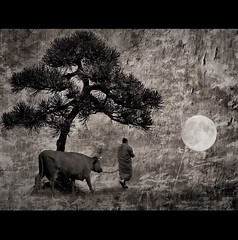
“Shinzen talks about how the ten zen ox-herding pictures can be interpreted in two different ways. One shows the stages on the path of enlightenment and the other shows you the process of truly grasping what consciousness is. Shinzen talks about pictures 1 thru. 4 in this first of three parts. Filmed on the second last evening of a 14-day intensive Jan. 9, 2009 at La Casa de Maria Retreat Center in Santa Barbara.”
“Shinzen continues in part two talking about pictures 5 thru. 7. He shares that the last three pictures 8, 9, and 10 tell us the substance, appearance, and ultimate use of enlightenment.”
“Shinzen talks about the “final cause” of enlightenment, and the historical person illustrated in the tenth ox-herding picture, the cloth-bag monk. He shares various examples of how retreat participants will be sharing gifts in the “marketplace” – the final goal of meditation practice.”
Visit Shinzen Young’s YouTube Channel for more videos on zen, vipissana meditation, Buddhism, consciousness, and philosophy of mind.
Greater awareness leads to greater action.
The more we are aware of each aspect of our life, the better equipped we become when making decisions and solving problems – which is a pretty often occurrence in our daily world…so why not spend the time to build the skills of living mindfully and fully conscious?
Of course due to our limited cognitive resources we cannot be aware of everything simultaneously. Instead, we must balance our awareness between different aspects of our lives: our career, our relationships, our health, and our happiness.
And finding a balance is rarely easy. Within a period of time, it is easy to get in the habit of pouring too much focus into one aspect of our life while neglecting others.
We are always relating with the world in different ways, and by being better aware of our actions and their consequences we can improve upon our skills, act more purposefully, and build upon the world in a way that we want to see it.
Gaining knowledge and spreading it to others is the best way to expand awareness on various social, political, and environmental issues. College campuses are some of the best mediums for this, where it is common to see protests regarding war, civil rights, abortion, cancer, poverty, the environment, and much more.
Newspapers, TVs, websites, blogs, and forums are all different tools to help spread awareness – to inform people on how to make better decisions. They change people’s lives, how they see the world, and how they behave.
Awareness can seem like a simple and harmless thing but it makes a real impact. People love to blame commercialism, advertising, propaganda, and other societal pressures for the evils of society, but rarely do we take the responsibility or time to expand our awareness by making the effort to seek information about things that are not right in front of us.
Being more conscious of our world can seem inconvenient and often not worth the effort. It won’t give you immediate pleasure or satisfaction like what you would get from eating a delicious dessert. No, awareness takes effort and determination to understand the interests of both your self and others, but it is worth it as time will prove later on.
Stay dedicated to the pursuit of growth, knowledge, and conscious living; but keep in mind your benefits will only be in proportion to your efforts. Conscious living is not a belief but a skill. With practice you can expand awareness in all areas of your life, both personal and social. Work on living mindfully, and remember each moment is a new opportunity to practice and improve your well-being. This is one of the most empowering ideas one can instill in their behavior.