Psychology and Self Improvement
Categories: Psychology | 3 Comments

It’s difficult to have to work in an environment that often stresses us out and drains us of our energy. Most of us probably spend between 30-50 hours a week dedicated to our job or career. It makes up a huge part of our lives. Yet we seem to accept the mantra that “work sucks,” so instead of trying to adjust our work environment and make it more pleasant, we learn to grin and bear it.

I object to this perspective.

I think a healthy workplace depends on our ability to feel more in control. And while some jobs don’t permit us with a lot of freedoms, there are always a few key things we can do to make our work environment more bearable and less stressful.

So let’s get straight to some of the things you can do.


Ease tension with coworkers and bosses.

Work Environment

Relationships can make or break a work environment. When people don’t get along and don’t know how to communicate effectively, there is a lingering tension in the office that can ruin everyone’s day.

We dread walking into the office, not because we don’t like what we do, but because we have to deal with an assortment of jerk-offs, bullies, whiners, and other vampires who suck up any positive energy in the room. Every office has them.

So what can we do? First, you have to learn how to let a lot of this negative energy just roll off your shoulders. The more you respond to negative energy in a negative way, the more you are contributing to the problem. Trying to reframe some of the negative aspects of work in a humorous or joyful way is often very effective for breaking the cycle of negativity in your work environment.

When someone makes a sly remark to you, just nod your head and smile. When someone gives you an order in a condescending tone, just imagine that person with a baby face talking in a really high-pitched voice. When someone starts a heated argument with you, know how to defuse it as soon as possible (whether that means cracking a joke or politely walking out of the room).

No, you won’t get along with everyone, but there will always be some people who you hit it off with better than others. Build solid relationships with these people. Get to know them better. Have lunch with them. Share interesting stories. Vent about work to each other. Having a work buddy (or two, or three) can really help you get through those tough days.

Also, if you have a bad past with some coworkers, try to fix them. You can try to patch things up with them, apologize for your mistakes, and start again on the right foot. Or – if they are truly that unbearable – try to deal with them on strictly business terms and minimize any excess interaction.

If you can, consider avoiding some vampires entirely. Some people you just can’t get along with no matter how hard you try. It’s very likely your work environment has one or two of these people. Recognize those boundaries. Sure, it’s not the ideal situation to be in, but it’s better than feeding into a destructive relationship and making it grow worse. If avoiding these people means moving to another office or part of the company, consider bringing up your concerns to management.


Make your office come alive.

Work Environment

Despite spending most of our work hours cramped in our office, we often spend very little time keeping it fresh and stimulating. The truth is that our surroundings, even when not consciously noticed, can have a huge effect on our mood and well-being. For example, studies have shown that the presence of plants in the workplace help boost people’s moods and increase cognitive functioning.

Another study has shown that when workers have more control over the design of their workplace, this improves their happiness, productivity, and even health.

Often when working for large companies we can lose a sense of our personal identity. Your office is usually the one place you are allowed to express yourself. Create a work environment that works for you. Something that reflects some of your own values and interests. And something that motivates and inspires you.

If this means changing your office around every few months or so – do it. Keep things interesting. Make your work environment stimulating (but not too distracting).


Have healthy snacks around.

Work Environment

A lot of people get so focused on their work that they sometimes forget to eat. Or they have so much to get done, that they have to skip lunch to make sure they meet their deadline.

I’m a strong believer that we need to stay healthy and nourished if we want to be effective at our jobs. Ignoring our bodies, and focusing all our energy on our work, is going to drain you and hurt your work ethic.

No matter what kind of work you do, your body and brain need fuel to do it. This means drinking water and having healthy snacks between meals to keep your body replenished. The less you take care of your body, the more it’s going to affect your work.

A fatigued body and mind can’t possibly work to it’s fullest potential, so keep yourself hydrated and nourished as often as possible.

This rule is actually pretty simple and easy to follow. Re-stock your office with healthy snacks every Monday: grapes, nuts, water, cheese and crackers, tuna, eggs, etc. If you have the choice, I recommend storing this stuff in a personal office vs. the company kitchen. This just makes it easier to access food when you are in the middle of work (and it prevents other coworkers from taking your stuff).


Identify the purpose of what you do.

I don’t expect everyone to romanticize the importance of their job. It’s true that not everyone has a career that really resonates with them deep-down. I respect that. But I also think most jobs serve an important function in our society. And when you recognize that you are an important part of what keeps society going, you sometimes find a new sense of purpose and pride about the things you do.

Ever seen the documentary The Philosopher Kings? It’s an interesting portrayal of some custodial workers at major universities (Duke, Princeton, U.C. Berkely, etc.) who are really passionate about their job. Now normally a custodial worker may not be a very revered job, but these workers clearly had a fire in their souls for what they did. They cared about where they worked and how it looked, and they recognized the importance of their job.

We could all learn something from these custodians. No matter what type of work you do, it plays an important role in our society. Sometimes you just need to look at the “bigger picture” of your actions, and how it fits into the grand scheme of things.


Question:

  • What are some things you do to create a less stressful work environment?


•••


Join now for more free updates on psychology and personal development.


Categories: Psychology | 10 Comments


1. The Persuasive Power of Swearing

    “To see whether swearing can help change attitudes, Scherer and Sagarin (2006) divided 88 participants into three groups to watch one of three slightly different speeches. The only difference between the speeches was that one contained a mild swear word at the start:

    ‘…lowering of tuition is not only a great idea, but damn it, also the most reasonable one for all parties involved.’

    The second speech contained the ‘damn it’ at the end and the third had neither.

    When participants’ attitudes were measured, they were most influenced by the speeches with the mild obscenity included, either at the beginning or the end.”


2. How Porn Can Hijack Your Brain

    “’The addictiveness of Internet pornography is not a metaphor,’ explains psychiatrist Norman Doidge in The Brain That Changes Itself. Porn users are seduced into pornographic training sessions that meet all the conditions required for plastic change of brain maps, namely, rapt attention, reinforcement, and dopamine consolidation of new neural connections.”


3. Women’s Grey Matter Grows After Giving Birth

    “A small study published by the American Psychological Association contradicts the long-held notion that motherhood addles a woman’s brain.

    Neuroscientists from the respected Yale University in the U.S. scanned the brains of 19 new mothers in the weeks after they had given birth.

    The results showed that the amount of grey matter – brain cells that crunch information – had increased by a small but significant amount by the time the women were three to four months into motherhood.”


4. Do Dogs Dream?

    “Many people believe that dogs do dream. Most dog owners have noticed that at various times during their sleep, some dogs may quiver, make leg twitches or may even growl or snap at some sleep-created phantom, giving the impression that they are dreaming about something. At the structural level, the brains of dogs are similar to those of humans. Also, during sleep the brain wave patterns of dogs are similar that of people, and go through the same stages of electrical activity observed in humans, all of which is consistent with the idea that dogs are dreaming.”


5. Hire Happy People!

    “Want your customers to have a better experience? Instead of trying to train your employees to smile, just hire happy people.

    Apparently, you don’t have to be an expert in reading faces to tell the difference between a real smile and a ‘social smile.’ The latter is what facial coding experts call the smile we use when it is socially appropriate to smile but we aren’t really filled with delight. In a social smile, we form a smile with our mouth but far fewer facial muscles are engaged. In his new book About Face, Dan Hill (who actually IS an expert in facial coding) reports:

      ‘Participants watched previously videotaped interactions that, unknown to them, had been staged between a hotel check-in clerk and a would-be guest. The variable was that for some check-in enactments the actress playing the clerk was invited to feel, then project, genuinely positive feelings toward the guest (true smiles). In other cases, the actress was instead told she had to smile (social smiles). Observers of the respective videos find the service performed with a truer smile far more satisfying.’


6. The Power Of Loss

    The Frontal Cortex blog has a fantastic piece on ‘loss aversion’ – the cognitive bias where try to we avoid losses more than we try to obtain gains – and its origin in the Allais Paradox.

    The crucial thing about loss aversion is it is not about just losing things – it’s also about the perception that we might be losing something, regardless of the actual impact on our resources.

    For example, people tend to be less keen to undergo surgery when it is described as having a 20% death rate than when described as having a 80% survival rate, even though both mean exactly the same thing.”


7. How Prozac sent the science of depression in the wrong direction

    “Prozac is one of the most successful drugs of all time. Since its introduction as an antidepressant more than 20 years ago, Prozac has been prescribed to more than 54 million people around the world, and prevented untold amounts of suffering.

    But the success of Prozac hasn’t simply transformed the treatment of depression: it has also transformed the science of depression. For decades, researchers struggled to identify the underlying cause of depression, and patients were forced to endure a series of ineffective treatments. But then came Prozac. Like many other antidepressants, Prozac increases the brain’s supply of serotonin, a neurotransmitter. The drug’s effectiveness inspired an elegant theory, known as the chemical hypothesis: Sadness is simply a lack of chemical happiness. The little blue pills cheer us up because they give the brain what it has been missing.

    There’s only one problem with this theory of depression: it’s almost certainly wrong, or at the very least woefully incomplete. Experiments have since shown that lowering people’s serotonin levels does not make them depressed, nor does it worsen their symptoms if they are already depressed.”


8. See No Shape, Touch No Shape, Hear a Shape? New Way of ‘Seeing’ the World

    “Scientists at The Montreal Neurological Institute and Hospital — The Neuro, McGill University have discovered that our brains have the ability to determine the shape of an object simply by processing specially-coded sounds, without any visual or tactile input. Not only does this new research tell us about the plasticity of the brain and how it perceives the world around us, it also provides important new possibilities for aiding those who are blind or with impaired vision.

    Shape is an inherent property of objects existing in both vision and touch but not sound. Researchers at The Neuro posed the question ‘can shape be represented by sound artificially?’ ‘The fact that a property of sound such as frequency can be used to convey shape information suggests that as long as the spatial relation is coded in a systematic way, shape can be preserved and made accessible — even if the medium via which space is coded is not spatial in its physical nature,’ says Jung-Kyong Kim, PhD student in Dr. Robert Zatorre’s lab at The Neuro and lead investigator in the study.

    In other words, similar to our ocean-dwelling dolphin cousins who use echolocation to explore their surroundings, our brains can be trained to recognize shapes represented by sound and the hope is that those with impaired vision could be trained to use this as a tool. In the study, blindfolded sighted participants were trained to recognize tactile spatial information using sounds mapped from abstract shapes. Following training, the individuals were able to match auditory input to tactually discerned shapes and showed generalization to new auditory-tactile or sound-touch pairings.”


Reminds me of a video:

Watch the full documentary here.


9. Why Laughter Is Contagious

    “How many times has it happened that when one person starts laughing, it takes no time till everybody else in the group starts rolling too? And now, researchers have found clues behind this common phenomenon and have explained why laughter is so contagious.

    Sophie Scott at University College London measured the brain activity of 20 volunteers in a functional MRI scanner while she played them laughter, squeals of triumph and moans of fear and disgust. She also played a neutral, artificial sound that would have no specific meaning to the subjects. It was found that all the emotive sounds triggered a response in the brain’s premotor cortical, the area that controls the movement of facial muscles.

    Inside the brain scanners, though, the subjects were not actually using these muscles. To Scott, that indicates the brain is wired with “mirror circuits” that prime us to copy another’s behaviour when we recognise their emotions.

    The brain response was more pronounced for the sounds of laughter and triumph than the vocalisations of negative emotions, suggesting that the urge to copy is greatest when we hear another’s delight or amusement.”


10. Being Suicidal: What it feels like to want to kill yourself

    “In considering people’s motivations for killing themselves, it is essential to recognize that most suicides are driven by a flash flood of strong emotions, not rational, philosophical thoughts in which the pros and cons are evaluated critically. And, as I mentioned in last week’s column on the evolutionary biology of suicide, from a psychological science perspective, I don’t think any scholar ever captured the suicidal mind better than Florida State University psychologist Roy Baumeister in his 1990 Psychological Review article , “Suicide as Escape from the Self.” To reiterate, I see Baumeister’s cognitive rubric as the engine of emotions driving deCatanzaro’s biologically adaptive suicidal decision-making. There are certainly more recent theoretical models of suicide than Baumeister’s, but none in my opinion are an improvement. The author gives us a uniquely detailed glimpse into the intolerable and relentlessly egocentric tunnel vision that is experienced by a genuinely suicidal person.”


Thank you for checking out this week’s PsychNews! Please subscribe to our RSS feed or join our newsletter for weekly updates and goodies. You can also follow us on Twitter @NeuralCorrelate.

Categories: Creativity | 22 Comments

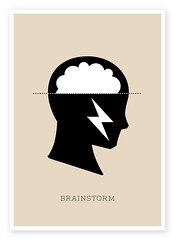
Brainstorming. The ability to be creative and solve problems.

I don’t care what your interests are, we all brainstorm in certain situations. We might be mulling over a mathematical proof, or planning a sneak attack in Call of Duty 4, or thinking of something to say to the girl who works at Starbucks – but all that counts, to me, as a form of brainstorming.

Brainstorming"

Image Credit: andymangold


We are most likely to brainstorm when we have a clear goal in mind. That’s the point. We want to get from Point A to Point B, but we don’t know how, so we have to first think about it for a little bit. Within this thought process we may reflect on past events, imagine future ones, or argue with other voices in our head telling us, “Are you sure this is going to work?” or “You’re crazy!”

Whether we brainstorm in groups or in solitude, brainstorming is a constant battle of ideas. Neuroscientist Mark Beeman claims that, while an everyday thought like what to eat for lunch may involve millions of neurons, an insight might only be tens of thousands. It might be that we are having creative thoughts all of the time, but they aren’t being listened to because they are largely happening underneath the surface, competing for our awareness.

When you enter other minds into the picture, like during a business meeting, the brainstorming process becomes even more dynamic. Not only do we have different neurons competing in an individual mind, but we also now have full ideas being verbalized, grabbing more of our attention, and synthesizing with other ideas.

The creative process can be chaotic, especially if we don’t have a methodological way of sifting through new thoughts and ideas, or letting other voices be heard. Setting some guidelines can be a good first start.


Tips for brainstorming in a business or organizational setting


    - Start off with 3-5 minutes of quiet writing time so each member can first brainstorm individually.

    - Have each member write down their ideas anonymously in order to limit social pressures that might hinder creative thought.

    - After, collect all the ideas in a hat, pull one, and spend some time discussing it as a group.

    - Encourage politeness and open-mindedness throughout the whole session.

    - Allow members to write down new ideas during discussion.

    - For extended meetings, make sure to include snacks and bathroom breaks. People that don’t have their physical needs met won’t be able to think as efficiently.

    - Don’t ignore the environment of the meeting. Choose something with vibrant and lively colors, but nothing too distracting.


Remember that you are trying to build a system where creative chaos can flourish, but also later be processed into something practical and useful. This requires a constant shifting of perspectives, both as a dreamer, and also as a critic and a realist. Once you begin scrutinizing these ideas, you can begin connecting, and as your visions begin to synthesize you might be getting closer and closer to that Eureka moment.

Most creative processes follow a similar pattern, but the form and context they take place in can be very different, so we don’t often think of them as comparable. This time instead of business I’m going to list some guidelines for a music band (notice the similarities and differences):


Tips for brainstorming in a music band

    - First ask each musician to warm up, go over scales, stretch, etc…

    - Musicians think with their instruments, so after warming up the best way to brainstorm is through jamming.

    - Give each musician a chance to start an idea, a riff, or a pattern, and then have the other musicians build around it.

    - Read each other’s emotions and attitudes. Ask, “What is trying to be communicated?”

    - Play off others and build an energy around the sound.

    - Speak out when you hear something you like.

    - Give helpful critiques when you hear something that can be improved.


In both scenarios you want to let everyone’s individuality be expressed, and then you want to try and integrate that into a more cohesive whole. That is what it means when people have creative chemistry.


Where Good Ideas Come From

Science author Steven Johnson spoke at a TED conference earlier this year about “Where Good Ideas Come From.” His theories come from an “environmental perspective,” meaning that good ideas rarely come from a single mind, but instead are likely to formulate when minds come together and exchange ideas in the right setting.

Most ideas, Johnson claims, take a long time to evolve. They remain dormant until our hunches combine with other hunches, and finally a full idea emerges. He says that the great driver of technology and science is our connectivity, and inventions like cellphones and the internet have become the primary engine of innovation.

Watch a great cartoon presentation of his lecture here:


His new book, “Where Good Ideas Come From” is coming out October 5th of this year! You can pre-order it here (or buy it depending on when you a reading this).


Individual minds and creative pairs

According to a recent article at Slate.com, there seems to be a debate among creative experts between what is more likely: the lone genius, or creative fusion when we work in pairs or in groups.

In a way this is a false dichotomy. Only individuals think, but their thoughts are very much influenced by their surroundings and interactions with others. If we were to take a newborn baby, put it in an isolated bubble and let it develop into an adult, it would have very few inputs to use toward creativity.

Rich minds always stay active and search for new experiences. They look at nature, visit New York City, talk to other like-minded individuals, and they also spend time alone, absorbing and reflecting on everything they have learned.

As an individual thinker, there are certain tips we can follow to enhance our creative output while interacting with our environment:

    - Carry a notepad or voice recorder with you everywhere you go.

    - Be interested and curious in everything.

    - Always seek new knowledge.

    - Talk to other creative people.

    - Try and look at things in unconventional ways.

    - Be more mindful of your thoughts.

Besides the advice to carry a notepad or voice recorder, a lot of this is about fostering the right attitude. Brainstorming and creativity is very much about how you see the world, and consequently how you interact with it.


Other great links on the creative process

Creativity is something that has always interested me. Not so surprisingly, there are many different ways to think about it. Here are a few links I’ve discovered over the past couple of months that give some interesting insights:

Categories: Productivity | 12 Comments

null


Yikes! Not only does it hurt to have to do so much work, but this stress then carries over into other aspects of our life. Thankfully there some strategies we can take to combat with a busy work schedule and still maintain sanity.


A. Re-think what counts

Sometimes work overload is really just a figment of our imagination. In actuality we may not have that much to do after a bit of re-scheduling, holding off, or cutting down on our to-do list. Find some things you can put off until next week. Also see if you can identify any tasks that you can just forget about completely. Often, “busy-ness” is something we only subject ourselves too when we don’t take the proper time to re-think what really counts. Learn to treasure a bit of minimalism, it’ll help you preserve energy for the more important stuff.


B. Take a siesta or two

As I mention in my one article, “reflection has shown to increase learning, memory, and other cognitive abilities. The more employers apply these revolutionary findings to the workplace the quicker we can move to what I hope to be a more enlightened age for modern capitalism.


C. Dedicate 10-15 minutes toward fitness

OK, we get it – you are “just too busy” to go to the gym. But fitness can be achieved anywhere as long as you have the creativity and dedication to integrate it into your routine. Try taking short breaks and do some push-ups and sit-ups in your office. By doing this you are taking your mind off of your latest assignment and rejuvenating your mental health. Taking an active approach to personal fitness is a great way to channel your stresses and at the same time boost your stamina throughout the day. CEOs take note: one article here illustrates how fitness in the workplace helps increase productivity by boosting employee self-confidence and company morale.

null

“Those who think they have no time for bodily exercise will sooner or later have to find time for illness.”
- Edward Stanley


D. Remember the importance of leisure

Leisure is anytime you are actively engaged in something of pleasure. Without the highs we would certainly have greater difficulty bearing the lows; leisure it is what makes life live-able. So, if you don’t already, find yourself some hobbies that really spark your interest and curiosity – something that energizes you and reminds you that there is a good life. And no matter how down or stressed out you may become there are always these one or two things available to lighten your mood.


E. Highlight what you like about your job

Most of us never achieved our childhood dream jobs. That is part of why the jobs we have can be so stressful and overbearing. But there is a mental thing you can do to learn to love your job more. First, make note of the aspects of your job that you do enjoy. That change in focus can help facilitate your workday, and the more you can learn to love, the easier time you will have.

I am not asking you to be delusional and all-smiles as you walk through the office, but to make the best out of what is, and learn the importance of a positive attitude. Rather than going into your day thinking, “Oh no, not another Monday,” instead think, “This will be a fun and productive day.”

What you are creating is a self-fulfilling prophecy – where your expectations affect your behaviors, and in return those behaviors elicit outcomes where your expectations actually come true. This phenomena has shown support in psychology ever since Robert Rosenthal and Lenore Jacobson published a study in 1968. It showed that when teachers have high expectations for students (even when based on false information) it leads to those students actually performing better on their IQ tests. Never underestimate the importance of your attitude and beliefs.


F. As a last resort: say “fuck it all” and take a day off

I would be lying to you if I didn’t include the age old “fuck it all” strategy. Of course it is a last resort, but sometimes it is necessary. I’ve done it myself during busy times of the year where I just need that extra day off to gather up my strength. Work is important, but it is not worth selling your soul for. The times where you feel most exhausted and overtaxed are the best times to stay at home and re-build yourself. But, I don’t recommend skipping out on days where you have an important business meeting or days when a big project is due – you have to use your own best judgment. Don’t do something that will get you fired.