In a new study published in the Journal of Family Psychology, researchers found that the balance between housework and leisure activity played a crucial role in workload recovery and lowering stress levels.
Researchers found that in families where both spouses work, individuals who spent more time doing housework reported higher evening cortisol levels (a biochemical correlated with stress) and poorer afternoon-to-evening recovery.
While husbands often spent more time on leisure activities than their wives, the study also indicated that when husbands help out with housework this can lead to lower stress levels for wives (although slightly higher stress levels for husbands). In addition, husbands whose wives spent less time on leisure activities had better after-work recovery times.
There a couple lessons here. One is that a cooperative household where both husbands and wives share housework is better for overall reduction of stress rather than an uncooperative household (where one spouse has a significant more amount of work than the other). The second lessons is one that I frequently mention on this blog: leisure time is important for life satisfaction (and, my guess, probably overall productivity as well).
But here’s the thing. People always say they are too busy to enjoy themselves. They come home from a rough day at work to find more and more chores to do: pick up kids from school, help with homework, cook, clean, pay bills, etc. But I believe that however busy you may be, it is absolutely necessary that you find time for leisure and relaxation. Here are some suggestions to help get work done and still find time for relaxation:
- Find ways to divvy up the work (have kids do small chores, carpool, etc.)
- Try to only focus on tasks that are absolutely necessary.
- Don’t let your inner clean freak get the best of you. Cleaning the house once a week should be fine.
- Make a schedule and leave time to actually enjoy yourself.
- The kinds of breaks you take are important: 20 minutes of meditation may be more rejuvenating to you than watching 2 hours of TV. Try new things and find what works best.
- Conscious practice over time can build a stable routine.
- Try to see if you can make some chores more fun by blurring the line between work and play.
- Also lower stress levels by taking more quality breaks during your workday (start by checking out this list of 50 Stress Relievers That Take 5 Minutes or Less).
- Don’t be afraid to take a 30-60 minute nap (when done right, it can boost alertness and productivity).
Again, these are just suggestions. And I realize some of this stuff is commonsense, but it’s worth reminding people about. I find people often underestimate the importance of leisure, but it’s something that – in my mind – is crucial to both productivity and life satisfaction. We need to know how to recharge our batteries. I’ve seen people just try to “push through” ridiculous work schedules; maybe sometimes it’s necessary, but it shouldn’t become the norm. Focus on smart work, not hard work, and part of that intelligence definitely includes well-spent leisure time. Enjoy yourself.
Join my newsletter for more!
Now that the holidays have come and pass, you are probably feeling more stressed out than ever. Not only are you tired from all the shopping, buying, gift wrapping, exchanging, returning, cooking, serving, and entertaining, but you are probably also stressed out that “vacation” is now over…and it is time again to get your ass back to work!

There are plenty of things to be concerned about. The economy continues to hurt, and this new hole in our wallets doesn’t help. On top of this, life’s daily burdens are always there to add fuel to the fire.
That is why it is important we set aside time for relaxation.
Over the past couple of weeks, I have been coaching some people who have various concerns about stress and anxiety.
Some folks are just tired from obligations with work and family, and they want to feel more at ease. Others get nervous in certain situations, like speaking in public or approaching a certain girl; they want to know how to overcome these worries.
Whatever the situation may be, my method for dealing with stress and anxiety is fairly simple but effective when practiced consistently. Here are some of the fundamentals to know so that you can begin on your own. You will find these concepts especially helpful to integrate into your new year workload. Here is to a more productive, more free, more spontaneous, and much more easy-going 2010!
Start With The Breath
When times get difficult, the breath is always there to draw attention to. I remember when I would lose my temper as a child and my parents would always tell me to “take 10 deep breaths.” At the time, I absolutely hated the advice, and it would only make me more angry. But overtime I have realized the power of turning our attention to our own breathing.
No matter how we are feeling, there is always a rhythm to the breath. It is consistent, it is always there, and that is what makes it such a reliable object of meditation.
The more consistent you are at bringing your awareness back to the breath, the more centered you will be throughout your day. This means you will have less of a dependency on certain outcomes: you will be able to let go of the things you can’t control, and dedicate more energy to the things you can control. In my article “How Stress Ruins Everything…” I mention how important this “control factor” can be in the accumulation of daily stress. And even when there are many situations where we don’t have much much control, we can always shift our focus to areas where we do have control, and by doing that we can maintain a healthy mind.
When I tell people to bring their attention to their breath, I tell them to pay attention to its subtle sensations: the feeling of cool and fresh air coming in and the feeling of warm and stale air coming out. I tell them to feel the sensations of air filling up their lungs. I then suggest they make notes of the motions of the breath, how it is steady and rhythmic like the waves of a calm sea.

The Black Cloud Of Tension
The next step I usually take is a visual exercise. I have the person imagine all their stresses, anxieties, worries, and concerns in the form of an ugly cloud. I usually have the individual choose how the cloud looks. I personally like mine to be a mixture of green and brown, like some kind of sludge from a raw sewage system. Others like to picture a thick black cloud as if it were from a burning building.
Whatever kind of cloud you may imagine, make it detailed and meaningful, and be sure it symbolizes all of your stresses and worries. Imagine the cloud coming from the exhalation of your breath and through the pores of your skin as it accumulates above you. Imagine yourself feeling lighter and more relaxed with each breath and moment that passes. Then let the cloud drift slowly away from you. Take your time with this process, feel the changes as they happen, and then allow yourself to go into a deeper state of relaxation.
Pay Attention To The Feelings
There is a difference between thinking about relaxation and actually being relaxed. We can imagine ourselves on a nice summer day, tanning at the beach, with a glass of lemonade and a good book. And like the black cloud example above, these visualizations will help. But it is just as important to pay attention to the subtle sensations that make up these experiences.
When you set aside time to be relaxed, make sure you feel your muscles stretching out and become less tense. Feel the little, nagging ache in your head dissipate. Feel light, more comfortable, rejuvenated, and fresh! Focus on these feelings. Become familiar with them, and that will help you re-create these states in the future.
When you are visualizing a relaxing scenario, associate yourself fully into the experience. Imagine what it would be like to have a black cloud of tension actually lift above you. What it would feel like? How does it change your physiology? What about if you were at a beach, or some other scenario where you find yourself comfortable and relaxed? Pay attention to the feelings.
Relaxation And Productivity
Allotting time towards feeling these states of deep relaxation can have tremendous benefits in our own productivity. Just like when we don’t get enough sleep, not enough relaxation can keep us in a drowsy and zombified state. That is why it is important to monitor and manage our energy, not just at night before bed, but throughout the day as well.
Bradley Whitwell, a Brain and Mind Research Institute senior research fellow, says that allowing employees to have mid-workday naps can help them become more alert and productive in the workplace. Other states of deep relaxation, like those found in a disciplined meditation practice, should yield similar result.
However, there are a couple of benefits deep relaxation techniques have over napping. To start, you don’t have to worry about waking up mid-REM when you consciously practice relaxation. You probably have had some experiences in the past waking up mid-REM, especially those naps where you end up feeling more tired and out-of-sync then you were beforehand.
Another benefit of consciously practicing relaxation is that you can better choose what times you spend to relax. You may only have 15-20 minutes before your next business meeting. A power nap could be risky, but spending that extra time focusing on your breathing can accomplish a just-as-desirable state without having to re-boot yourself completely. In this way, “conscious relaxation,” as I have been calling it, is of much greater convenience than your typical afternoon nap.
Type-A Personality And Health Implications
Being stressed and busy-minded is easy. Despite how little we may enjoy it, we can drain ourselves fairly “effortlessly” just by going through our daily motions. We get so easily caught in worrying about little things like, “What am I going to make for dinner?” or “Did I forget to take out the trash again last night?” that we forget to take a step back to catch our breath.
Maybe this tendency towards busy-ness is because we find it more natural to overexert ourselves then to just sit and be comfortable? There are so many societal pressures to multi-task and be productive, rather than to spend time sitting in leisure without being called a bum. This doesn’t make either more important.
I think we should find a balance. Despite how much we have been conditioned to see virtue in this busy lifestyle, especially those of us like me who live near a major industrialized city, relaxation can help both our quality and quantity of life. Sure, having a Type-A personality may get you a few extra thousand dollars a year, but the stresses could just as well take off ten or more years of your life. One 9-year study with over 9,000 men, aged 35-59, found that Type A personalities were more than twice as likely to have coronary heart disease.
Meanwhile, a report by BBC News illustrates that countries who take part in afternoon rests (or siestas) are less likely to suffer from heart disease and other similar risks.
Don’t be someone to work your entire life towards material gains but never have the time to enjoy any of it.

Relaxation Takes Practice
Without practice, sitting with the intent of relaxing can prove to be much more difficult than we first imagine. Sometimes with all of our worries and concerns it can even make us more anxious and uneasy. That is why I tell people “relaxation takes practice.”
One of the most common hurdles to relaxing is that we get too wrapped up in our thoughts. We begin thinking about how we need to get X, Y, and Z done before next week, or we can’t stop re-playing in our heads that stupid thing we said to our girlfriend earlier that morning. I won’t say that these concerns are a waste of time. There may be a time and place for them – but not during relaxation.
For now when we devote time to being relaxed, we need to let our thoughts pass without putting too much emphasis or energy into them. If you are focused enough on the process of relaxing, then you won’t have the energy to mind these thoughts and worries. They will arise, but they will pass. Just stay in-tune to your own state of rest and comfort. That is what you are doing now, while you are relaxing. So be fully aware and concentrated on that.
But this concentration will take practice. Most likely you will get distracted during the first few times you try to cultivate these states. It is okay and normal, but be aware that it is up to your own time, effort and dedication to make this practice work. It is not just about reading this post, but setting aside the time to do it.
One Last Thing
In summary, I want you to focus on relaxation as a valuable endeavor. No matter what point of your life you may be, there are probably stresses and anxieties you are dealing with. Therefore I want you to practice these tools, become familiar with them, and integrate them into your daily routine. There is a great benefit to being able to relax, replenish your energy, and re-direct it in a more alert and focused state of being.
How To Improve Your Computer Posture
Nowadays many of us in the industrialized world spend way too much time sitting in the classroom, workplace, or living room watching TV. According to one study, Americans spend more than eight hours a day in front of televisions, computers, cellphones or other devices.
This is not what our bodies have been evolutionary designed to withstand. Our ancestors would spend the majority of their waking hours migrating, hunting, and gathering in order to find food and shelter to survive. They were always on their feet. But now with the rise of video games and technology we have even more distractions to decrease our time being physically active.
One result of too much time spent sitting is poor posture, which according to doctors and chiropractors has become somewhat of an epidemic in the United States. Another study even showed how poor body posture can affect confidence in your own thoughts. The importance of good posture for a healthy body and mind cannot be underestimated.
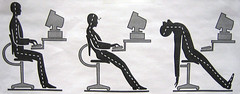
Computers are of course becoming one of the biggest contributors to bad sitting posture. I know this is certainly true for me, but how many of us can honestly relate to the first image above where our spine would be perfectly erect? More than likely – our bodies resemble the last two photos, where our bodies are slouched either forward or backward.
But we can’t avoid computers for the rest of our lives, they have become an integral part to modern society, so why not adapt to them in a way that optimizes good health? This doesn’t mean we have to blog less or stop going to work – it simply means we take some time to focus on building better computer posture.
First we need to become more conscious of how we sit throughout the day, then we can correct it and over time build it into an automatic habit.
Here are some tips you can apply to help correct your sitting posture and improve your physical and mental health:
1. I first recommend to watch this short video on The Alexander Technique, an incredibly powerful tool designed to improve body awareness, posture, and coordination. It was first developed by a Shakespearean actor between 1890-1900 in order to alleviate breathing problems and hoarseness. It is not widely used in various physical therapy facilities, dance schools and acting studios. Here is another video posted by the British Medical Journal in response to a study showing the positive effects of the Alexander Technique on pain and physical stress.
2. Of course having good sitting posture is a huge plus, but why not also try to actually be active while sitting on the computer? In fact, according to some studies physical inactivity is beginning to pose one of the biggest health risks to Americans.
So what types of things can you do while on your computer or watching TV? You’ll notice that even while sitting up straight you can still mobilize your head, neck, shoulders, hips, and legs. Try to see how many different stretches you can do while still sitting at your computer desk. Sometimes after long periods of time sitting down I simply continue what I am doing on the computer while standing up (no one says you have to sit down while surfing the web right?). In a standing up position you can get even more little exercises accomplished while still doing things on the computer. My only warning is to make sure you adjust the height level of your computer monitor so that your neck doesn’t have to bend down to see the screen.
3.Take a short 3-5 min. break from the computer every hour or so. Do some push ups or sit ups, take a lap around the office, or do more in depth stretching – but whatever you do make sure it is some sort of physical exercise.
Wrapping Up
Of course, like all good things, the hardest part is first being aware of what you are doing wrong. This means seeing where your body is building up physical stresses, which parts aren’t being properly attended to, and observing when your posture gets lazy. Consistency is key if you want to build these habits into your natural way of acting.
I recommend dedicating a whole week or two to posture awareness and see what you learn. Find your weak points and then work from there. For those who are already trained at applying mindfulness to everyday activities this should already be a familiar practice. For those who aren’t yet skilled in mindfulness, this may not be a bad place to start; the Alexander Technique after all is a technique of mindfulness.