

Spot the nudges already shaping your daily life and find ways to make them work to your advantage.
A “nudge” is any small change in how a choice is presented that can influence our behavior in a measurable and predictable way.
Many organizations, including governments, businesses, schools, and nonprofits, use nudges to influence people’s choices in different situations. The goal is to make a particular choice more likely, without mandating it or using economic incentives.
One common illustration of a nudge is a cafeteria placing healthier foods at eye level and junk food in less visible places. All the same foods are available, but the healthier options are easier to notice.
We can also create nudges to change our own behavior. “Mindless nudges” make certain choices more automatic. “Mindful nudges” create a moment of awareness that helps us reconsider what we’re doing.
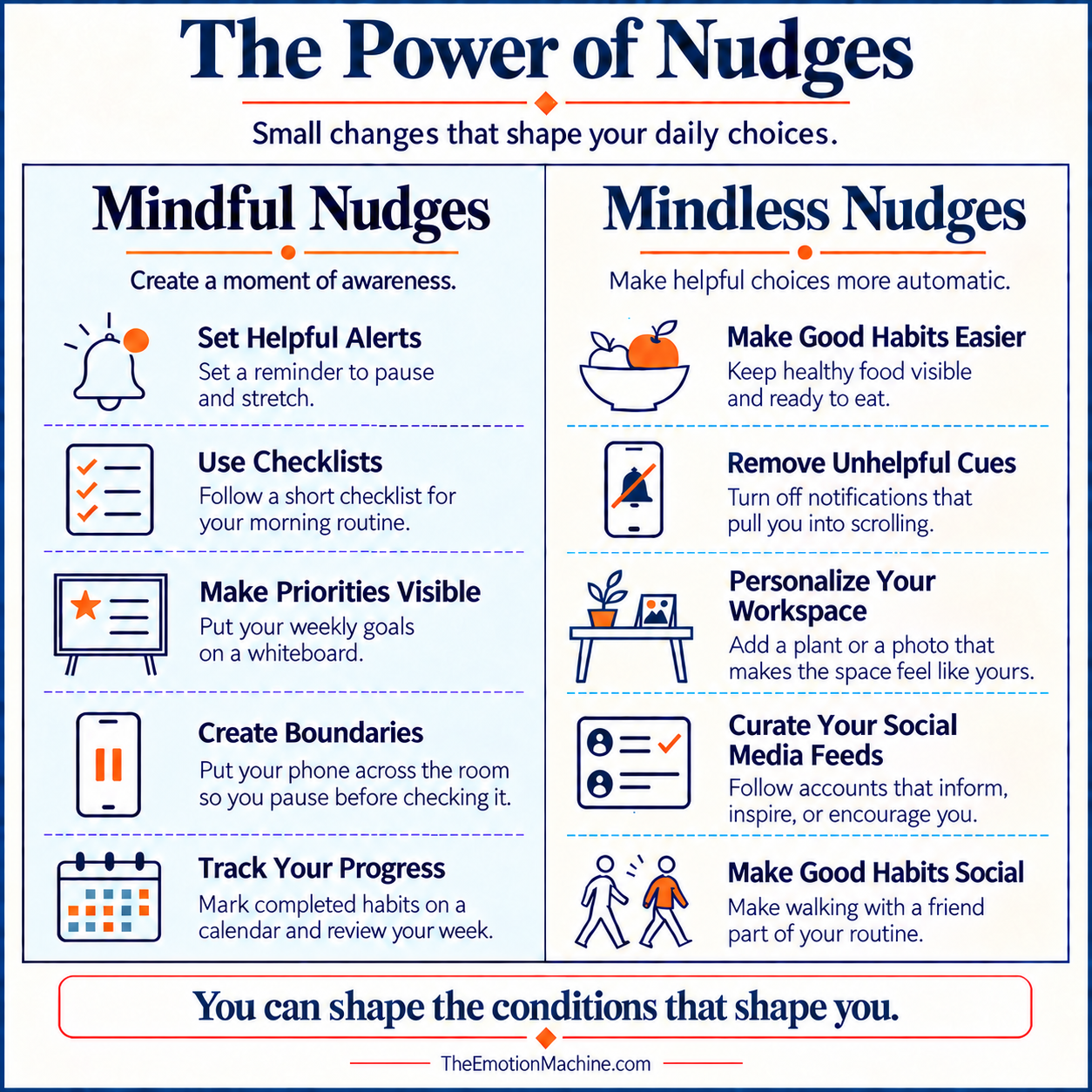
Mindless Nudges
Mindless nudges can change how we think and behave without us noticing their effect. These can be subtle changes in how a choice is presented or how the environment is arranged.
- Default – One of the most common nudges is to make the desired behavior the default option. When people use a new product, service, or website, they are much more likely to keep the default settings rather than change them. It’s easier to keep the status quo. A website can turn data sharing on by default when you sign up, so you have to take the extra step to change the setting if you don’t want to share your information. Making organ donation the default option, with the choice to opt out, has also been shown to increase consent to organ donation.
- Framing – Another common nudge is to present the same situation from a different perspective. Describing a choice in terms of what someone might lose or “miss out” on can be more effective at changing behavior than focusing on what they might gain (drawing on what psychologists call loss aversion). Framing can also change how we see a product: in one study, people rated the same ground beef more favorably when it was described as “75% lean” rather than “25% fat.”
- Visual Cues – Simple visual prompts like a sign or picture on a wall can influence how people behave. Arrows on the floor can guide people through a building. Colors in a restaurant may change what food people order. In one interesting study, people gave more to charity on average when there were pictures of eyes on the walls. Researchers suggest that the feeling of being watched can encourage more honest and generous behavior.
- Anchoring – Anchoring is our tendency to rely too heavily on the first piece of information we receive when making decisions. In one study, two groups were asked to estimate the population of Ukraine. Before making their estimates, one group was asked whether the population was above or below 22 million, while the other group was asked whether it was above or below 68 million. The group given the higher number made higher estimates on average because their guesses were anchored to the initial number. In another study, real estate agents toured the same house but were shown different asking prices. The agents who saw a higher asking price tended to put a higher value on the house. Anchoring can even affect how we judge sound: when people tried to match the volume of a music clip they’d just heard, those who started with the volume set too high ended up at a louder setting than those who started with it set too low.
- Social Influence – When we see other people behave a certain way, we tend to mimic their decisions. This is known in psychology as the “bandwagon effect.” We might think to ourselves, “Well, if a lot of other people are making this choice, then it must be a good choice and I’ll make it too.” In two field experiments, researchers made phone calls to try to increase voter participation. In one script, they emphasized that “voter turnout was expected to be low,” and in the other script they emphasized that “voter turnout was expected to be high.” When voters were told that participation was expected to be high, they were more likely to say they planned to vote as well. The people you regularly spend time with can also shape your habits. A friend who eats well and goes to the gym regularly can make those habits feel more normal and doable. If you start going to the gym together, you can also hold each other accountable.
Mindful Nudges
Mindful nudges make us more conscious of the choices we’re making. A brief pause or reminder at the right moment can help us step back and think about something we’d normally do out of habit.
- Boundaries – The more steps a behavior requires, the harder it becomes to act automatically. For example, if you keep junk food and unhealthy snacks in a locked cabinet, that extra step of unlocking it gives you a moment to think about whether you really want to follow through. On the other hand, it’s far easier to grab a bunch of M&M’s without thinking when the jar is already sitting on your desk in plain sight. Learning how to create boundaries between you and your bad habits is one effective way to minimize them.
- Earmarking – The basic idea behind earmarking is to allocate resources like money or time to a specific purpose. With money, you might set up categories like “Vacation,” “College,” “New Home,” or “Emergencies.” This way, if you’ve already earmarked money for college or a vacation, spending it on something else feels like you’re taking money away from that goal. In one field study, households given an envelope to keep their savings separate from the rest of their cash saved more of their income over six months than households given no designated envelope. You can earmark time, too: if you’ve set aside Saturday morning for writing, saying yes to another plan means giving up writing time.
- Partitioning – To partition is to divide something into smaller portions so you have more chances to decide whether to keep going. For example, if you’re eating from one big bag of popcorn, it’s easy to keep reaching in. But if that same amount is split into three smaller bags, finishing each bag gives you a moment to decide whether you want to open up another. Research suggests that these extra “decision points” can help us slow down, especially with habits we’re trying to cut back on. You can do something similar with TV by turning off autoplay so you have to decide whether to start the next episode. Or, when browsing a news feed, pick three articles, open them in separate tabs, and close the feed. Once you’ve read all three, you can decide whether to go back for more (this can also prevent tab overload).
- Alerts & Reminders – A reminder brings something back to your attention when it’s time to act on it. It could be something as simple as taking the garbage out or leaving for a doctor’s appointment. You can also set an alert to bring your attention back to the present moment and create a new “decision point” for yourself. For example, during a long work or study session, you can use alerts to check in with yourself and decide whether to keep going, take a break and grab a snack, or get back to work if you’ve drifted off.
- Visible Progress – It’s easier to stick with something when you can see how far you’ve come or how much longer you have to go. When people are waiting in an online queue for customer service or standing in line at the DMV, they want to know that their commitment isn’t in vain. An updated wait time can show people how much longer they have to wait, or a progress bar can show people how much of an online form they still have to fill out. You can apply the same technique to personal goals. You could mark the days you go for a walk on a calendar, or make a tally mark on your whiteboard every time you practice guitar. Both are simple ways to track your progress so you can look back and evaluate how you’re doing.
The possibilities for creating nudges are practically unlimited. You can design them around your own habits, surroundings, and personal associations. Even an ordinary object placed somewhere unusual can become a useful reminder if it means something to you. These examples are a starting point for discovering what works in your own life.
What’s a behavior that you’ve been wanting to change? Reflect on the nudges mentioned above and think about how you could adapt one to help.
Creating our own nudges takes creativity and experimentation. When you try a new nudge, check whether it’s helping you make the choices you want. It often helps to track your behavior and focus on implementing just one nudge at a time.