How do our environments shape who we become?
Our environments include more than the spaces around us. They include the media we consume, the technologies we use, the people we spend time with, the routines that structure our days, the beliefs we learn, and the traditions we inherit.
Since 2009, The Emotion Machine has grown from a practical guide to psychology and self-improvement into a broader project connecting personal change with the culture and systems around us.
Through articles, quizzes, worksheets, and practical tools, it helps people better understand the inputs shaping their lives—and make more deliberate choices about what they strengthen, resist, or reshape.
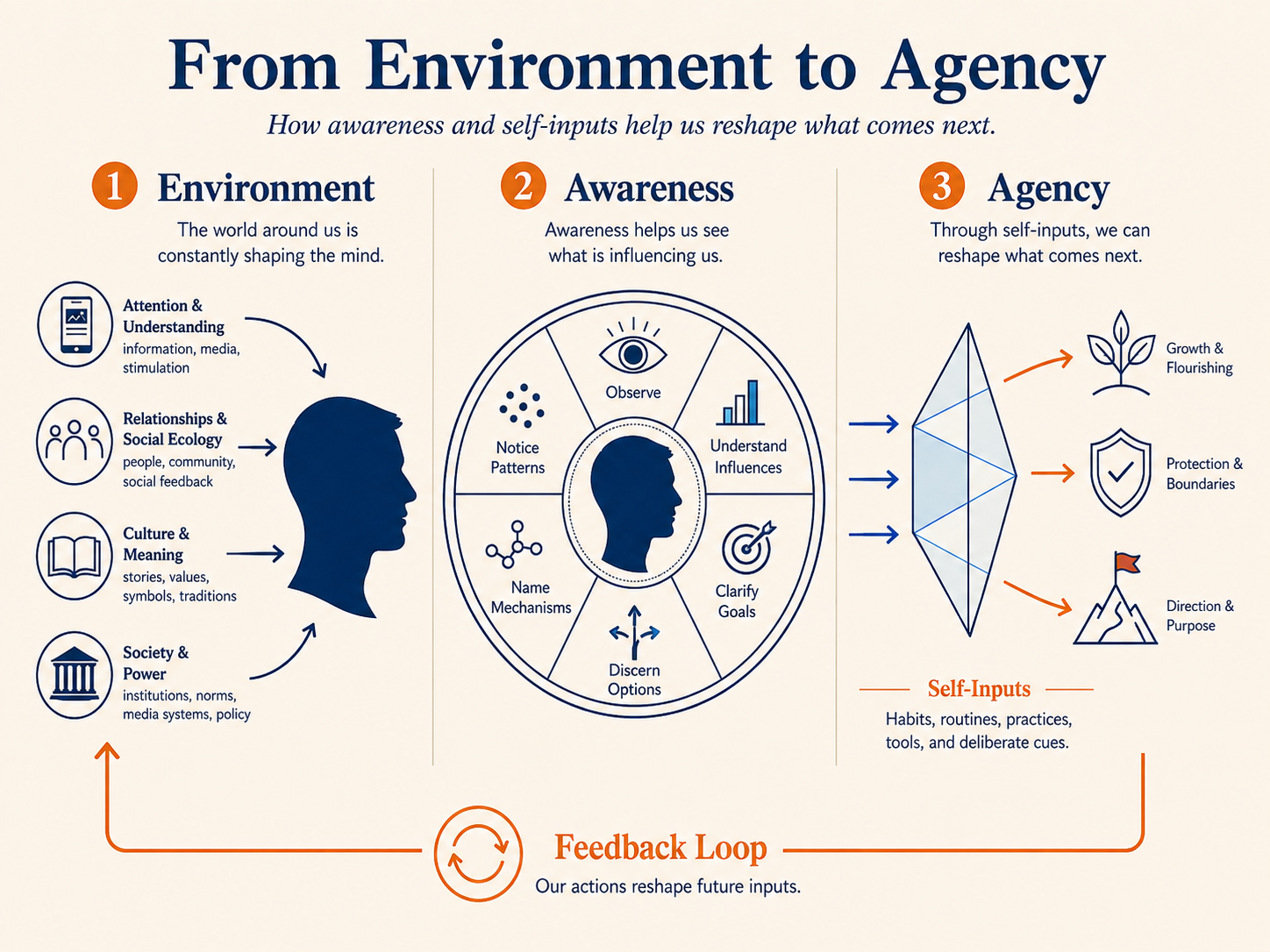
Self-improvement can only take us so far if we treat the individual as an isolated problem to solve. We end up ignoring the wider ecosystem we’re a part of.
The Emotion Machine is interested in both sides of that equation: how people change themselves, and how we build a world that makes better change possible.
One way this philosophy takes shape is through Better Inputs, a framework for paying closer attention to what we repeatedly take in and reinforce through our habits, relationships, media, and culture.
It’s a lens for exploring everything from social media and technology to art, beauty, tradition, and the myths and stories that shape our ideas about how to live.
Reshaping the World
Look around. Some of the systems shaping us are producing bad outcomes. Passive adaptation isn’t enough.
Our information streams are increasingly crowded with manipulation, outrage, shallow stimulation, and incentives that reward whatever captures attention fastest. These inputs don’t stay outside us. Repeated often enough, they become us.
This calls for discernment, not doom. We need better filters for what we consume, stronger reference points for what matters, and the will to reshape the environments that keep feeding us the same patterns.
We don’t need to escape the world. We need to change the streams people are swimming in.
That means asking harder questions about the media we reward, the technologies we build, the places and institutions we inhabit, and the stories we pass down. What deserves to be strengthened? What should be resisted? What needs to be reshaped?
Changing ourselves is part of the work. Changing the conditions shaping us is the larger task.
About Me
I’m Steven Handel, the founder and writer behind The Emotion Machine. I started the site in 2009 while studying psychology at Binghamton University, originally as a way to better understand my own struggles and share the ideas and tools I found useful along the way. After earning my B.A. in Psychology, I chose to keep building the project independently. In 2018, Ulysses Press published my first book, Small Habits, Big Changes.
Psychology has always been the starting point, but my interests have gradually expanded into culture, technology, philosophy, art, music, and the larger forces shaping how people live. I’ve also spent years making electronic music and previously worked at a music and arts venue in Brooklyn, experiences that deepened my interest in creativity, culture, and how ideas move through communities.
I now live in St. Petersburg, Florida, where I continue to write, make music, and build The Emotion Machine. After more than fifteen years, I’m less interested in preserving what the project has been than discovering what it can become. I think our most important work is just around the corner.
Join The Emotion Machine
The Emotion Machine has always been an independent project. It grows through people who read the work, use the resources, share the ideas, and help keep the project moving forward.
If this way of looking at psychology, culture, and personal change resonates with you, there are a few ways to take part. Become a member for full access to the TEM library, join the newsletter to follow new work, or simply share something you think deserves a wider audience.
I’m also interested in hearing from people who see the larger potential of this project and want to help build what comes next. If you have ideas, skills, resources, or a perspective that could move The Emotion Machine forward, get in touch.