

Common sense has a history. The Springfield Plan is one example of how institutions can carry an idea downstream until it becomes part of everyday life.
The beliefs and norms we take for granted didn’t come out of nowhere.
Many ideas that feel like our own were already in the cultural waters around us, shaped by institutions before we ever consciously considered them. We absorbed them through cultural osmosis. But how did they get in the water in the first place?
When you trace the origins of certain beliefs, you often find institutions that helped develop, legitimize, and spread them.
I call these origins cultural headwaters. The process is rarely controlled from beginning to end. Different institutions may pursue overlapping goals, translating and reinforcing the same ideas across multiple channels. Their combined power can give certain ideas the legitimacy, repetition, and reach needed to make them feel natural and self-evident.
The framework below shows how ideas can move from funding and academia through journalism, policy, and culture before settling into everyday norms.
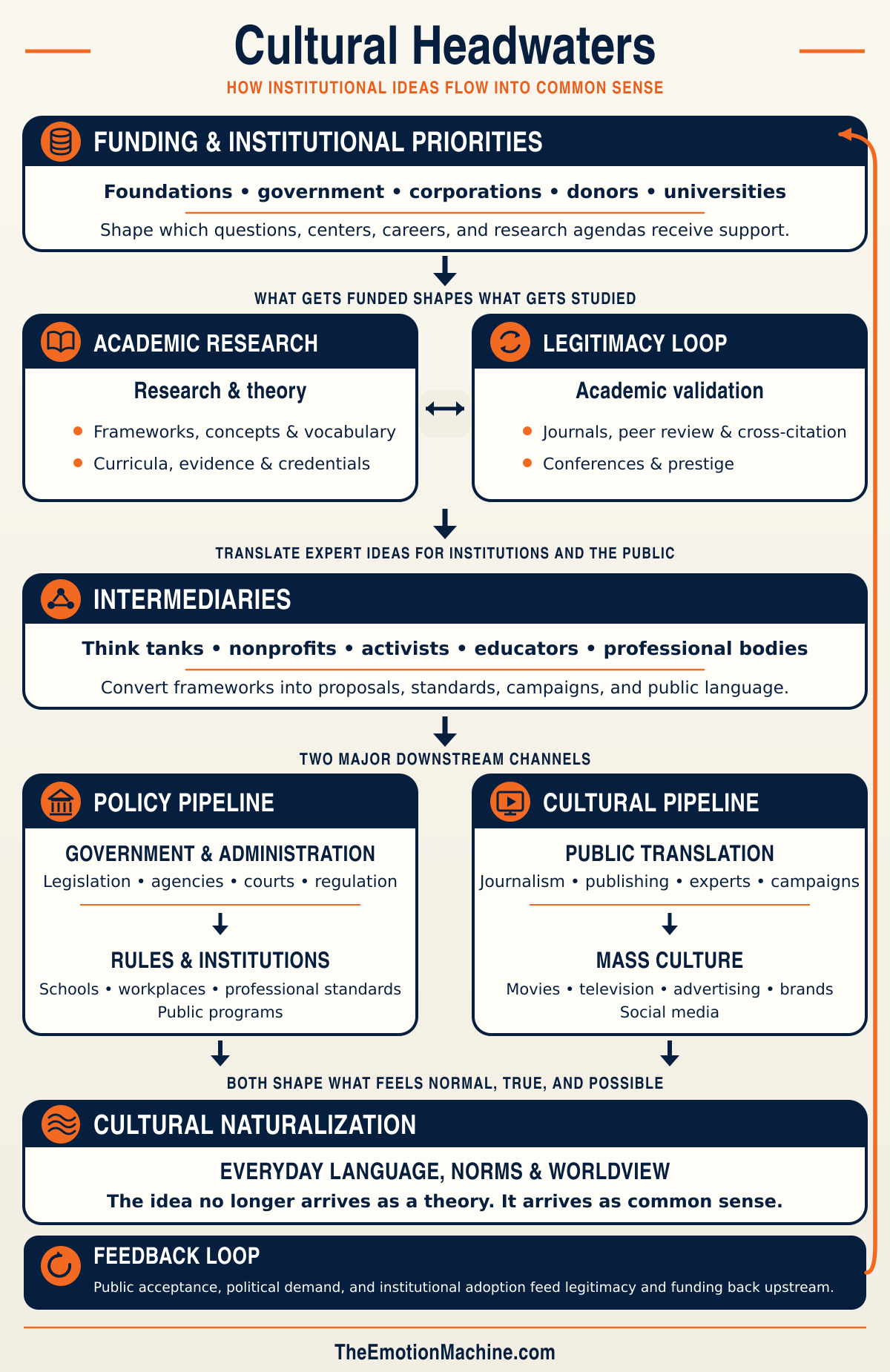
This is not a complete model of how ideas become common sense, but it is a useful framework for analyzing the origins of particular beliefs. It prompts questions such as:
- Where did the idea originate?
- Who funded it, and who gave it legitimacy?
- Who translated it for a mainstream audience?
- Which institutions adopted and distributed it?
- Which cultural products made it memorable?
- How did it enter habits, policies, and ordinary language?
- What remains after the institutional fingerprints disappear?
This framework is ideologically neutral. It describes how ideas gain influence, not whether they are good or bad.
From Propaganda Analysis to the Springfield Plan
The Springfield Plan offers an unusually clear example of cultural headwaters in action.
In the 1930s, social scientists became increasingly concerned with how mass media and propaganda could influence democratic societies.
That concern became especially urgent amid the spread of Nazi propaganda abroad and homegrown antisemitism within the United States. Populist figures such as Father Charles Coughlin broadcast antisemitic conspiracy theories to tens of millions of American listeners. Antisemitic attitudes were far from marginal: a 1938 Gallup poll found that 65 percent of Americans believed the persecution of European Jews was partly or entirely the Jews’ own fault.
Against this backdrop, the Institute for Propaganda Analysis was founded in 1937 with the stated mission of giving ordinary citizens the tools to detect and independently analyze propaganda.
A $10,000 seed grant from philanthropist and retail magnate Edward Filene made the Institute’s launch possible. One of its driving figures was Clyde R. Miller, a professor at Teachers College, Columbia University, who would later become the chief architect of the Springfield Plan.
Launched in Springfield, Massachusetts, in 1939, the Plan was a citywide education program developed collaboratively by Miller and Springfield educators, drawing directly on his work in propaganda analysis. It was sponsored by the National Conference of Christians and Jews and soon supported, promoted, and replicated through a much wider institutional network.
The Plan aimed to reduce racial and religious prejudice by promoting a vision of democratic citizenship built around tolerance, brotherhood, equality, and fair play. Its organizers described this as making democracy “work” for Springfield’s students and citizens.
In the classroom, students learned to recognize propaganda and stereotypes, discuss controversial issues, and practice democratic decision-making through structured exercises. But that was only one layer of the program.
The Plan took what we might call an Ecology of Inputs approach. Its organizers believed that children absorbed prejudice from their entire environment. Changing school lessons would accomplish little if homes, churches, workplaces, and media continued teaching the opposite. The program therefore worked across multiple layers of the community at once.
Here’s what that wider ecosystem looked like:
| Function | Institutions, Organizations, and Channels |
|---|---|
| Intellectual Framework | Teachers College, Columbia University; Institute for Propaganda Analysis; Progressive Education Association |
| Sponsorship and Advocacy | National Conference of Christians and Jews; Council Against Intolerance in America; Pictures for Democracy; League for Fair Play |
| Local Implementation | Springfield Public Schools; Springfield Board of Education; superintendent’s office; Adult Education Program; Parent-Teacher Associations |
| Community Embedding | Churches and synagogues; citizenship classes in factories; employers and hiring programs; labor, business, civic, social, and youth organizations |
| Local Media | Springfield Union; Springfield Republican; local radio |
| State and National Support | Massachusetts Governor’s Committee for Racial and Religious Understanding; Massachusetts Department of Education; National Education Association |
| Teacher Training | Springfield College; Boston University; Harvard University; Wellesley College; teacher workshops and institutes |
| Professional Publications | Journal of Educational Sociology; Elementary English Review; Harvard Educational Review; Child Study |
| Popular Publicity and Endorsement | Woman’s Home Companion; Parents’ Magazine; Menorah Journal; Christian Science Monitor; Eleanor Roosevelt’s endorsement in her nationally syndicated “My Day” column; Frank Sinatra’s public endorsement during the 1945 Gary school strike |
| Books, Film, and Television | Viking Press; Barnes & Noble; Americans All (March of Time/Time Inc.); It Happened in Springfield (Warner Bros./Vitaphone); WNBT television broadcast in New York (1945) |
| National Replication | American Council on Education’s Intergroup Education in Cooperating Schools; University of Chicago Center for Intergroup Education; National Council on Cooperation in Teacher Education; 24 participating teacher colleges |
| Replication Sites | Pittsburgh Public Schools; Ontario Ministry of Education; Welland and Kirkland Lake schools |
The Plan was also carried into popular media. The 1944 March of Time newsreel Americans All presented Springfield as a model that other communities could follow in combating racial and religious intolerance.
At the same time, funding continued to drive the program’s expansion. The National Education Association allocated $25,000 in 1944 to spread its educational materials, followed by a $100,000 NCCJ initiative through the American Council on Education in 1945 to train educators and reproduce the model nationally.
The Springfield Plan continued as a distinct program until 1947, although many of its practices remained in place afterward. In a 1955 history of the NCCJ, Springfield superintendent William J. Sanders was quoted as saying:
-
“The principles of the Plan are now embodied in our common practice. The formal outlines of the plan have atrophied with maturity in the same manner that certain lymphatic glands atrophy when the child is well on its way toward adolescence. The Springfield Plan, then, is one which has accomplished its purpose and its principles are living on in the bones and flesh of the Springfield Public School System.”
The Plan’s ideas did not spread merely by winning an intellectual debate. They passed through an entire ecosystem of institutions, where they were translated into personnel policies, classroom habits, scientific lessons, children’s art, religious ceremonies, factory programs, hiring rules, books, films, conferences, and professional training. By the time many of the Plan’s principles became moral common sense, the institutional fingerprints behind them had largely disappeared.
As the Springfield Plan entered its final years, closely related ideas were already gaining prominence in major Hollywood films. In 1947, RKO released Crossfire and Twentieth Century-Fox released Gentleman’s Agreement, two major films specifically confronting antisemitism. Both were nominated for Best Picture: Crossfire received five Academy Award nominations, while Gentleman’s Agreement received eight nominations and won three awards, including Best Picture.
Why Counterpropaganda Mirrors Propaganda
The Institute for Propaganda Analysis taught citizens, including students, to identify key propaganda techniques. Meanwhile, the Springfield Plan itself benefited from many of the same mechanisms of persuasion:
- Testimonials: Endorsements and recommendations from famous figures such as Eleanor Roosevelt and Frank Sinatra.
- Glittering generalities: Repeated appeals to democracy, tolerance, brotherhood, equality, and fair play.
- Transfer: Authority and prestige borrowed from universities, science, churches, government, the military, and Hollywood.
- Plain folks: Ordinary children, parents, teachers, workers, soldiers, and immigrant families were used to embody the message.
- Card stacking: Carefully selected stories, photographs, and films that highlighted success while minimizing resistance, failure, and continuing discrimination.
- Bandwagon: Publicity emphasizing nationwide praise and other school districts joining the movement.
Beyond these individual techniques, the Plan benefited from sheer repetition, with similar messages circulating through books, newspapers, magazines, radio, film, television, public forums, and professional training.
This shouldn’t be too surprising. Propaganda works because it draws on ordinary features of the human mind. Counterpropaganda has to work with the same raw material.
In this way, propaganda analysis is not necessarily the opposite of propaganda. The same tools used to dismantle one system of persuasion can help construct and defend another.