
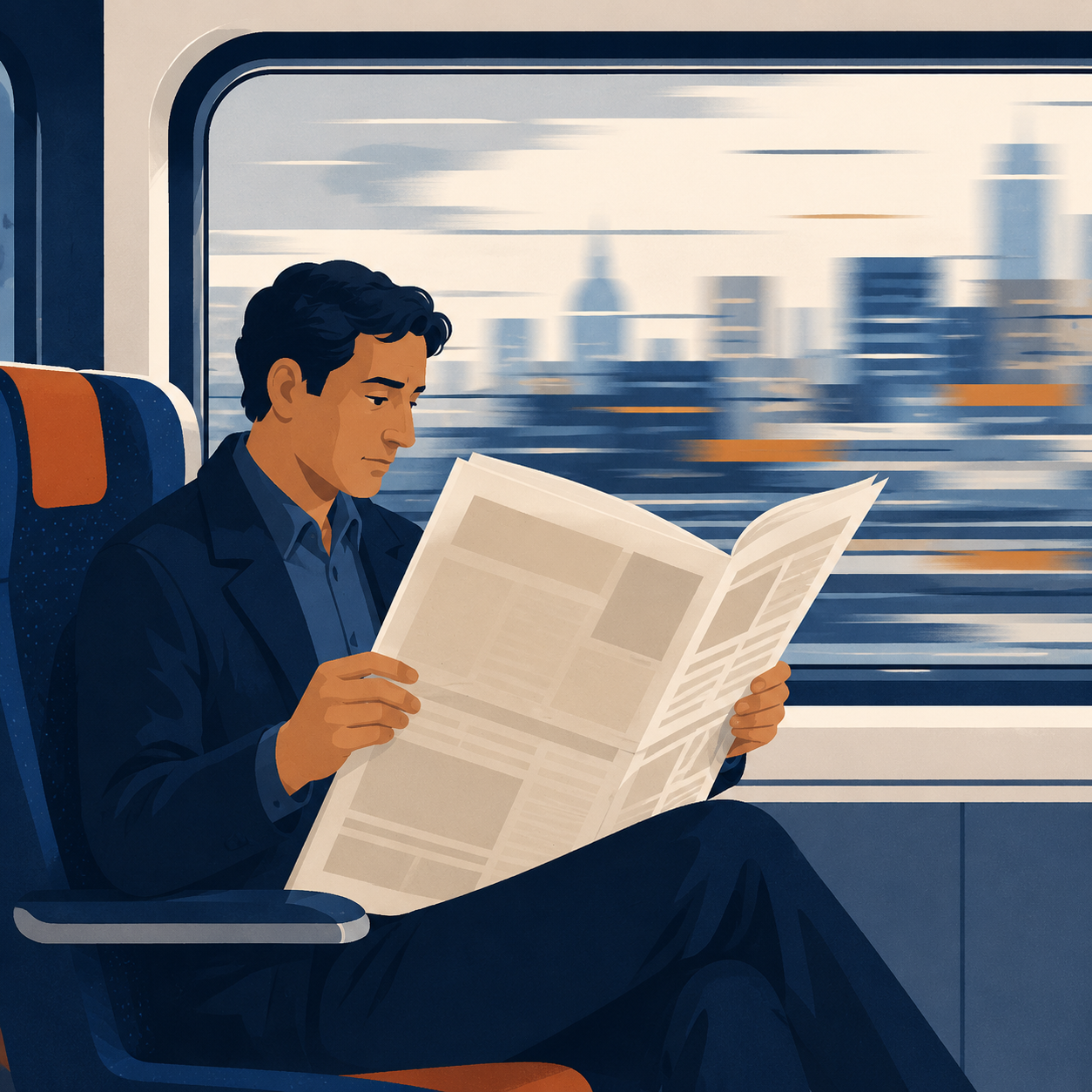
Following the news closely can make us feel informed while leaving us without the context needed to understand what we’re seeing. Deeper landmarks help us connect events into a larger picture and keep our bearings in the endless news cycle.
Is the person who follows the most news necessarily the most informed?
We tend to assume that more news creates a clearer picture of the world. But someone can closely follow every new development while losing sight of the larger story connecting them.
Philosopher and sociologist Jacques Ellul gives this condition a memorable name in his book Propaganda: The Formation of Men’s Attitudes:
-
“This situation makes the ‘current-events man’ a ready target for propaganda. Indeed, such a man is highly sensitive to the influence of present-day currents; lacking landmarks, he follows all currents. He is unstable because he runs after what happened today; he relates to the event, and therefore cannot resist any impulse coming from that event. Because he is immersed in current affairs, this man has a psychological weakness that puts him at the mercy of the propagandist. No confrontation ever occurs between the event and the truth; no relationship ever exists between the event and the person. Real information never concerns such a person.”
Current-Events Man sees every event, but he cannot see the current.
That doesn’t mean he is uninformed. He may even know more details about the latest news story than the average person. The problem is that all this information never gets integrated into a wider map of reality.
He has a worldview built from headlines, without deeper historical or philosophical anchors. When the headlines change, his picture of the world changes with them.
When the News Feed Erases the Past
As soon as the next story breaks, the previous story becomes yesterday’s news, never to be revisited.
Today’s news can get memory-holed quickly, not just through censorship or deletion, but simply by being crowded out by the next shiny thing. There’s a reason “Friday news dumps” exist: damaging information is released when fewer people are paying attention, in the hope that the weekend will bury it before Monday. Current-Events Man is especially vulnerable to this.
Current events feel immediate and important. This taps into our recency bias: our tendency to give more weight to new information. That sense of urgency narrows our field of vision. We focus on the latest scandal or spectacle while losing the history, institutions, and recurring patterns underneath it.
Media researchers distinguish between two broad ways of framing the news:
- Episodic framing: “What happened today?”
- Thematic framing: “What keeps happening – and why?”
Episodic framing comes naturally to the daily news cycle. Every new event gives us something immediate to discuss with family, friends, coworkers – or argue about on the internet.
Current-Events Man asks, “What is everyone talking about today?” and jumps right in. He rarely steps back to connect one event to the next or ask the deeper question: “How did we even get here?”
The Feeling of Being Informed
In the feed era, Current-Events Man doesn’t believe he needs to seek out every story himself. He trusts that major stories will show up in his social media feeds or be mentioned by friends. Researchers call this the “news-finds-me perception”: the belief that anything important will eventually reach us.
One 2026 study of South Korean internet users found that incidental exposure to news on social media was associated with a stronger news-finds-me perception and a greater feeling of being informed. However, when participants took a short quiz about politics, how informed they felt didn’t match their objective knowledge.
The feed can increase the feeling of being informed without reliably increasing knowledge.
Passive news consumption doesn’t always look passive. Current-Events Man may refresh his feed constantly, skim dozens of headlines, and argue online. He is active in the conversation while remaining a spectator in society.
Without a wider worldview, news can become little more than entertainment. Another form of bread and circuses. The feed decides which events Current-Events Man sees, how they are framed, and what lessons he takes away from them – if any.
Build Landmarks
Current events aren’t necessarily bad inputs. They’re just incomplete without context. They tell us where to look, but not necessarily what we’re looking at.
We need deeper inputs to supply the missing landmarks. When a current event catches your attention, ask yourself:
- History: What came before this? What led up to it?
- Pattern: Does this keep happening? What earlier events resemble it?
- Structure: What institutions and incentives helped produce it? What keeps it going?
- Follow-through: What happened after everyone stopped watching? How did it actually turn out?
These landmarks help you place events inside a longer timeline and keep your bearings in the endless news cycle.
You don’t need to abandon current events. Just complete them.