
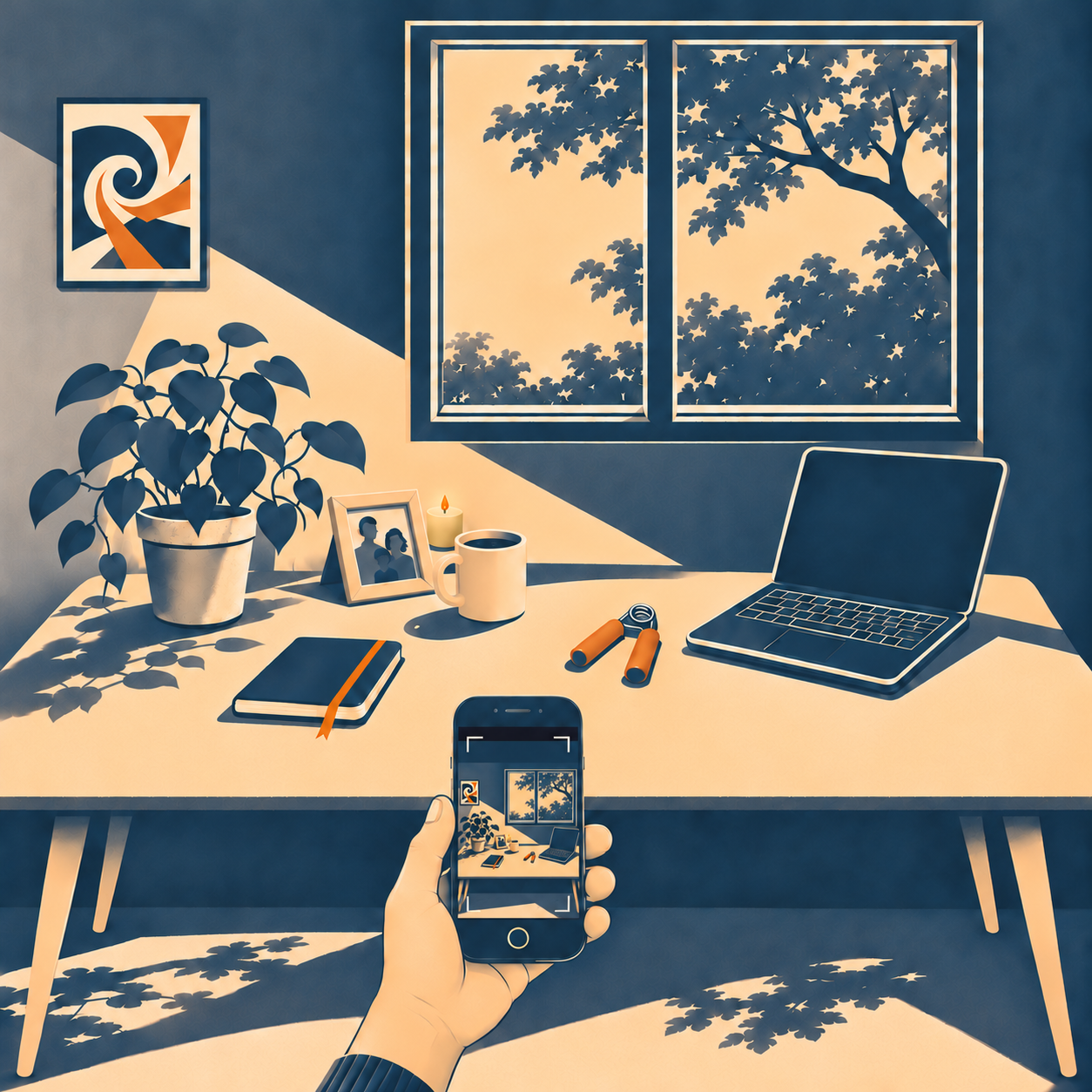
One ordinary day. Five photos. Discover the small details that shape your habits and mood.
Pause. What’s in front of you right now?
We tend to see the same things every day, and after a while, we barely notice them. Our daily routines and surroundings are interlinked and feed into each other: places can prompt habits, and habits can bring us back to the same places.
In one interesting 2026 study, researchers sent participants phone alerts at random times throughout the day for seven days. At each check-in, they were asked to report how they felt and snap a photo of their immediate surroundings. This allowed researchers to look for relationships between what people saw during everyday moments and how they felt at the time.
Think of these familiar surroundings as your “visual defaults,” the things you regularly see as you go through your daily routines. Some can act as nudges, like a book beside your bed inviting you to read or running shoes by the door reminding you to go for a walk.
Taking photos throughout the day can help you notice what’s often in your view and consider how it might be influencing you. You can borrow a simple version of this method to take a closer look at your own daily surroundings.
Try your own one-day photo diary and see what you find:
- Pick an ordinary day and set three alerts. Choose one time in the morning, one around midday, and one in the evening.
- Take a photo when each alert goes off. From wherever you are, photograph what’s already in front of you. Leave things as they are. If two photos look almost identical, keep both.
- Take two wild-card photos. At any point during the day, snap a picture of something that catches your eye. It could be a patch of sunlight or the pile of mail you keep glancing at.
- Look at all five photos together that evening. What caught your eye on its own? What showed up more than once? What do you notice that you rarely pay attention to anymore? Does having it there make anything easier to do or harder to ignore?
For example, one of my photos showed my work desk in the morning. The coffee and laptop were obvious, but I also noticed the hand gripper sitting in clear view. It’s something I use throughout the day without even thinking about it anymore. A blank notebook that I keep by me every day also prompts me to take more handwritten notes when I get a good idea.
Your home and work environments will likely show up often in your photos, since those are the places where you spend much of your time. Because you repeatedly return to these environments, small changes to what’s in view can become part of your everyday routine. By moving, adding, or removing things, you can create new visual defaults.
In the photo journal study, researchers used AI to rate how strongly each photograph fit into nearly 1,000 exploratory categories, such as food, reading, exercise, and indoor plants. These factors came from earlier research linking them to positive affect, negative affect, or stress.
Photos with higher ratings for greenery, sports, colors, or crowding were significantly associated with higher positive-affect scores, a measure that included how active, awake, and attentive participants felt. Examples of photos that scored high in each include:
- Greenery: Visible vegetation, such as trees, grass, or indoor plants.
- Sports: Activities and places equipped for them, such as runners on a track, a soccer game, or a lap pool.
- Colors: Scenes where color stands out, such as multicolored markers, colorful climbing holds, or even a solid red image.
- Crowding: Scenes that look visually packed, such as a crowd of people, a dense clothing display, or a canopy of overlapping leaves.
These broad category scores can hide important differences between scenes. A photo that scored high for “colors” could show a lively nature scene or simply be a solid red image. The AI also gave relatively high “greenery” scores to images it described as floral fabric or digital renderings of trees and gardens, showing how the category could also include artificial representations of nature.
Despite its limitations, this study offers a promising way to explore connections between our visual defaults and how we feel. Science aside, there is value in paying attention to our daily surroundings and considering their impact on us on a personal level.
Try keeping a one-day photo diary and see what comes into view.