
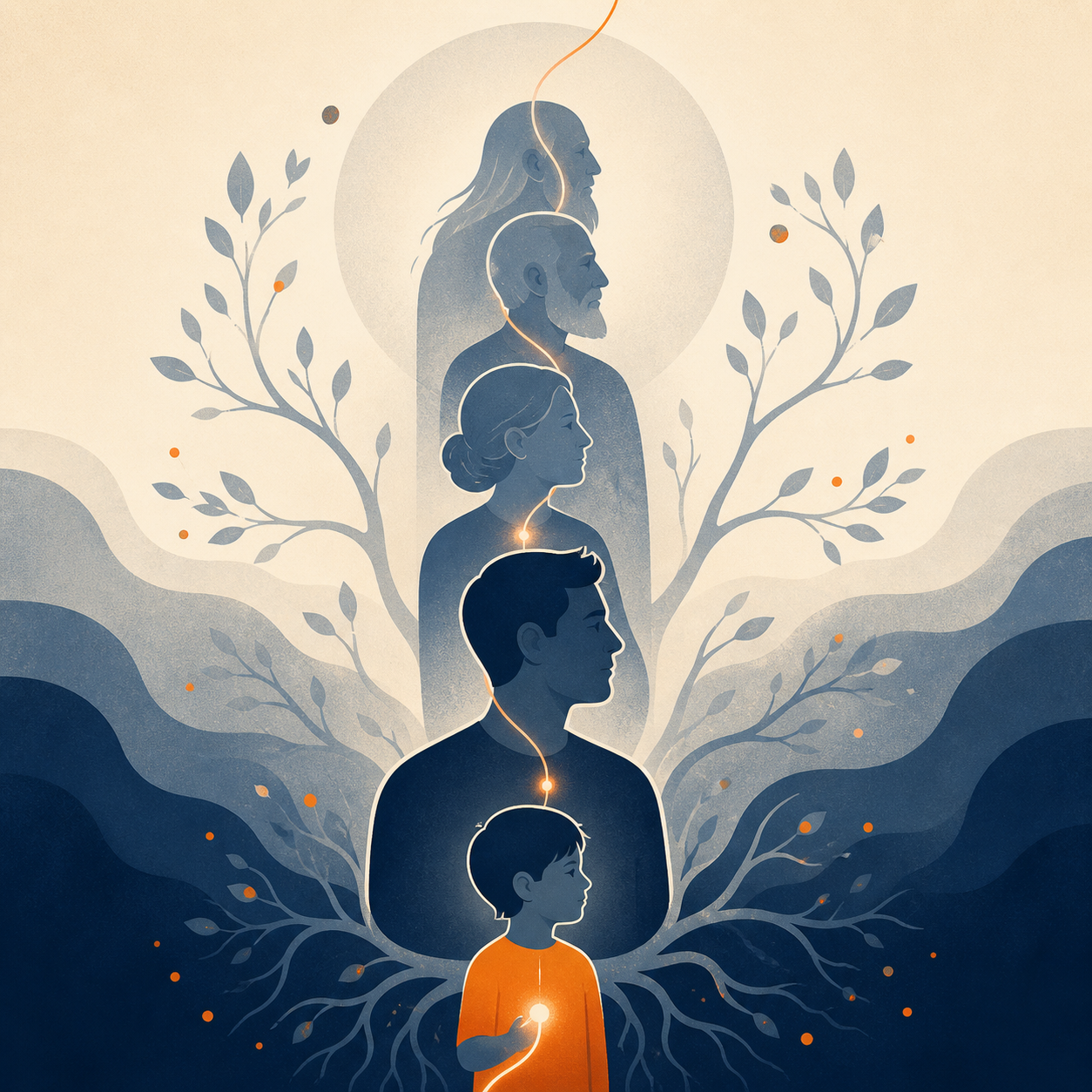
Keep the wisdom. Break harmful cycles. Discover everyday ways to leave something better for the next generation.
We are not just isolated individuals whose lives begin at birth and end at death.
Every human being is part of a complex web of cause and effect that stretches well beyond our individual lifetimes.
Before you were born, hundreds of past generations had to live, survive, and reproduce for you to exist today. They passed down not only their genes, but also their traditions, culture, knowledge, wealth, and habits.
We’re all influenced by this past in different ways and to different degrees, whether we’re aware of it or not. For better and for worse, we are where we are today due to the actions of our ancestors.
Human civilization is a product of intergenerational effects. Ideally, each generation builds on the work of past generations to create a better world for those who come next.
As the classic proverb goes, “A society grows great when old men plant trees whose shade they know they shall never sit in.” We have many unknown planters to thank.
The world as it exists today didn’t come out of nowhere. It’s the result of many generations of science, technology, culture, tradition, religion, art, music, and philosophy. We’re all indebted to the past in one form or another.
When we start looking at our lives through this intergenerational lens, we recognize that we’re part of a much larger picture.
Your life is one chapter in an epic story, and realizing that can create an extra layer of meaning behind everything you do.
Of course, everyone will relate to their past in a different way. There’s no single way to tell your story, although some interpretations may be healthier and more constructive than others.
Our past is important, but so is what we do for the future.
In a 2026 survey from the American Psychological Association, 58% of U.S. adults doubted that future generations would inherit a better world than the one they themselves had inherited.
Intergenerational thinking asks us to consider what we can pass on, even when the future feels uncertain. One place to start is by building stronger relationships across generations.
Modern society is often structured to keep age groups apart, from schools to retirement communities. This leaves many of us with less regular contact with people much older or younger than we would have in a more age-integrated society. Connecting across age groups creates more opportunities to find mentors, peers, and students, sharing knowledge and skills in both directions.
One study published in The Journal of Positive Psychology followed sixth-grade students who spent the school year learning and doing activities alongside elders in a long-term care community. Participants felt better and more connected on days when they had meaningful contact across generations. This link was stronger toward the end of the school year, after participants had spent more time together.
This mindset can shape everyday choices, from the traditions we preserve to the example we set for others.
How to Practice Intergenerational Thinking
- Recognize that you’re interconnected with many past, present, and future generations of humanity.
- Remember that nothing in the past dictates your future. Treat it as a resource for learning and growth, while still choosing how to respond moving forward.
- Identify family patterns that are common among different members, including similar habits, behaviors, health conditions, careers, or personality traits. Do you see any of these traits in yourself? Be honest.
- Practice family rituals and holiday traditions that still resonate with you. Pass them down to the next generation if possible.
- Collect sentimental objects or old photographs from your past. Share them with others.
- Explore your family history by talking to relatives and looking through old photographs and records. You might also consider an ancestry test. Save what you discover in a scrapbook or put together a family tree.
- Share stories — whether around campfires like our ancestors or at family gatherings and reunions — to pass knowledge and culture from one generation to the next. Encourage older people to share their stories, advice, and wisdom, and take an interest in younger people’s experiences and perspectives.
- Learn more about human history, especially about traditions or cultures you identify with, including popular folktales, myths, art, or music.
- Minimize conflict and hostile feelings toward “older” and “younger” generations. Recognize that every generation has its own perspectives and biases, and that you can learn something from each.
- Practice a loving-kindness meditation to cultivate positive feelings and good intentions toward everyone.
- Stay connected with meaningful people in your life. Don’t underestimate the power of checking in on family and old friends, even if you haven’t spoken in a long time.
- Understand that your actions and choices in life also influence future generations, including how you treat people, how you treat your environment, and the example you set for others.
- Our actions have a bigger effect than we realize. Research shows one simple benevolent act can cause a ripple effect of kindness through a group of people.
- If you have children, make it a priority to give them a positive childhood, even if you didn’t have one. Some intergenerational cycles need to be broken.
- Contribute to future generations through education, art, music, volunteer work, charity, social activism, environmental conservation, or other efforts that benefit others.
Everyone plays a role in shaping the future. By looking beyond ourselves and our own lifetimes, we can be more deliberate about what we pass on and how we contribute to the bigger whole.