

Low trust can deepen atomization, making everyday connection feel like more effort than it’s worth and retreating into our own homes the easier choice.
What causes us to want to stay inside and not socialize? One often overlooked factor is the culture and social environment around us.
With the ongoing disintegration of the community, many of us barely know our neighbors. Staying home to watch TV just feels easier than inviting a neighbor over.
Harvard political scientist Robert Putnam is known for his research on social capital: the networks of relationships and habits of trust and reciprocity that help people cooperate. His work documents a broad decline in American community ties beginning in the late 1960s.
His famous book Bowling Alone takes its title from fewer people joining bowling leagues, but it traces a wider decline in community participation, including voting in elections, attending PTA meetings, and going to church.
Screens offer an easy place to retreat, but they are not the only reason we stay inside. Putnam’s earlier work considered mobility and urban sprawl, changes in family structure, and technology and mass media as possible contributors to this trend. In a 2007 paper, he turned to another factor: the demographic composition of our neighborhoods.
Putnam compared how much people trusted their neighbors across American communities with how ethnically mixed their neighborhoods were. Here’s what he found:
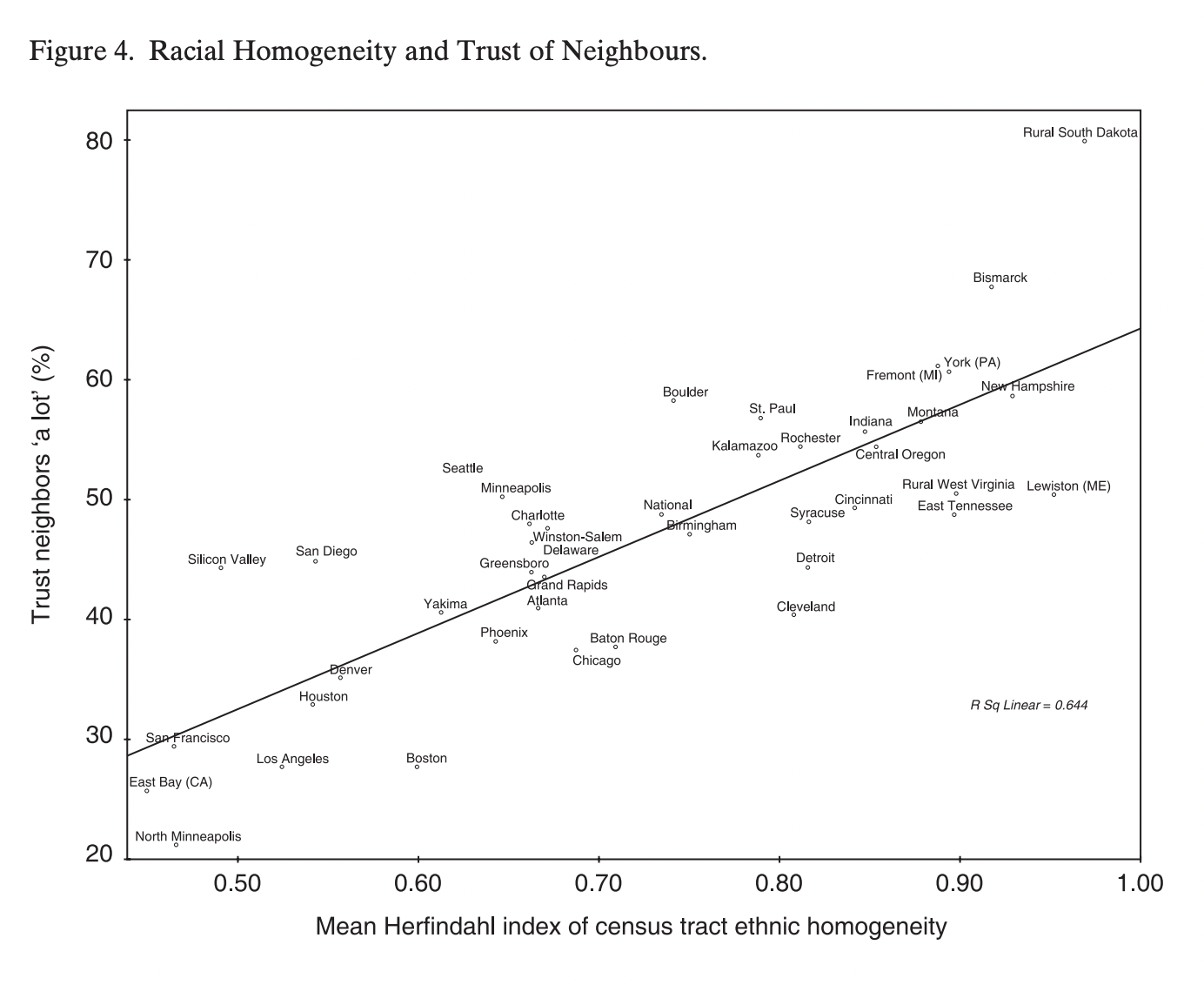
Farther right means more ethnically homogeneous neighborhoods; higher up means a greater share of residents said they trust their neighbors “a lot.” The graph shows a correlation, and the association remained in Putnam’s separate analysis after accounting for poverty, crime rates, residents’ age, income, education, and other personal and local differences.
In Los Angeles and San Francisco, about 30 percent of respondents said they trusted their neighbors “a lot.” In Bismarck, North Dakota, it was nearly 70 percent.
The surprising part is that this wasn’t a simple “us versus them” pattern. People in more diverse communities reported less trust even in their own group.
A general distrust of our neighbors can lead us to pull back from community life and “hunker down” at home. As Putnam puts it, “Diversity, at least in the short run, seems to bring out the turtle in all of us.”
Life in a Low-Trust Neighborhood
The differences between high trust and low trust neighborhoods show up in everyday life in many ways, from lending a tool to a neighbor to feeling comfortable leaving your door unlocked at night.
People in high trust neighborhoods are more cooperative and invested in their community. They not only say hi to each other, but also collect mail for a neighbor who’s away for the weekend, arrange carpools for their children, and join neighborhood cleanups after a storm.
That cooperation can improve the neighborhood itself, from getting potholes fixed to maintaining local playgrounds. Even people who don’t socialize much can benefit from living in a high trust community, where neighbors look out for one another, help keep sidewalks and shared spaces clean, and take part in neighborhood watch programs.
In contrast, people in low trust neighborhoods tend to be more individualistic. They are less willing to offer help, exchange favors, reach out to neighbors, or participate in community activities.
Over time, people can start asking, “Why bother?” It feels easier to hunker down in your personal silo than to make the effort to connect with a neighbor. That withdrawal can feed on itself: the more people pull back, the fewer opportunities everyone has to connect. This is how atomization takes hold: many people can live near one another while feeling increasingly disconnected.
Putnam’s findings went beyond trust in neighbors. People in more diverse communities also reported fewer close friends and confidants, were less likely to volunteer or work on community projects, and spent more time watching television.
One great illustration of why social trust matters is the lost-letter thought experiment. Imagine addressed, stamped envelopes containing money are dropped around town. How many would reach their intended recipients with the money still inside? How many people would simply keep the money for themselves?
Your answer will say a lot about how much you trust the people in your own neighborhood.
It probably doesn’t help that Americans can expect to move roughly 12 times over their lives, according to a Census Bureau estimate based on 2007 data. Moving to a new neighborhood often means starting over socially, making it harder to establish roots and build long-term social connections.
Bonding vs. Bridging: Why Connection Takes Work
In a 2001 paper titled Birds of a Feather, researchers describe how people are more likely to form bonds with those who are similar to them. This pattern, known as homophily, appears across many types of relationships, including marriage, friendship, workplace connections, and social support networks. The researchers also note that ties between dissimilar people tend to dissolve more often.
This is a natural pattern, but it can also limit our ability to connect with people outside our social bubble.
Putnam distinguishes between two types of social capital: bonding and bridging. Bonding often happens among family, close friends, and people who share our background or outlook. This shared understanding reduces the work of connecting.
Bridging often requires extra effort. It involves forming relationships with people who are different from us, often extending our social connections beyond our immediate circle of empathy. Bridging is especially important in civic engagement and political activism, where people with very different backgrounds and views need to find common ground and work toward a shared goal.
Sports leagues, events at local parks, and neighborhood cleanups can create opportunities for bridging. However, these activities need organizers to get them started, which can be even harder in neighborhoods where trust is already low.
In theory, bridging can help diverse communities pull together and build social capital over time. Putnam argues that the initial “hunker down” response can be overcome as people develop shared identities and stronger connections. His study compared communities at one point in time, so it couldn’t establish whether those same communities would become more trusting over the years.
Unfortunately, it’s still unclear whether Putnam’s optimistic projections for the future will come true. A later 2020 meta-analysis of 87 studies also found a modest overall negative association between ethnic diversity and social trust, strongest for trust in neighbors. Whether that association diminishes over time remains an open question.
And the continuing decline in social capital makes rebuilding these connections even more challenging. As Putnam has emphasized in his recent interviews, things have only gotten worse.
If you find yourself wanting to hunker down, it isn’t necessarily a personal failing. Your social environment can make reaching out feel like more effort than it’s worth, even when you want to connect. People are more likely to come out of their shells when they believe someone will meet them halfway. But someone has to make the first move.