

Shallow isn’t always bad. Deep isn’t always good. A simple 2 x 2 framework for sorting the influences in your life and shaping a more nourishing mix.
Life is a series of inputs.
You sit on a park bench reading a book while birds sing overhead, the sun hits your face, and people walk past. Your attention follows the words on the page, but the surrounding world hasn’t stopped reaching you.
Inputs include anything entering or repeatedly acting on your mind. A passing conversation is an input. So is a family tradition you’ve lived with for so long that you rarely think about it.
Inputs reach us on multiple levels, from the personal to the social to the institutional. They can be shallow or deep, and they can be nourishing or degrading.
Here’s a simple 2 x 2 framework for evaluating the inputs in your life:
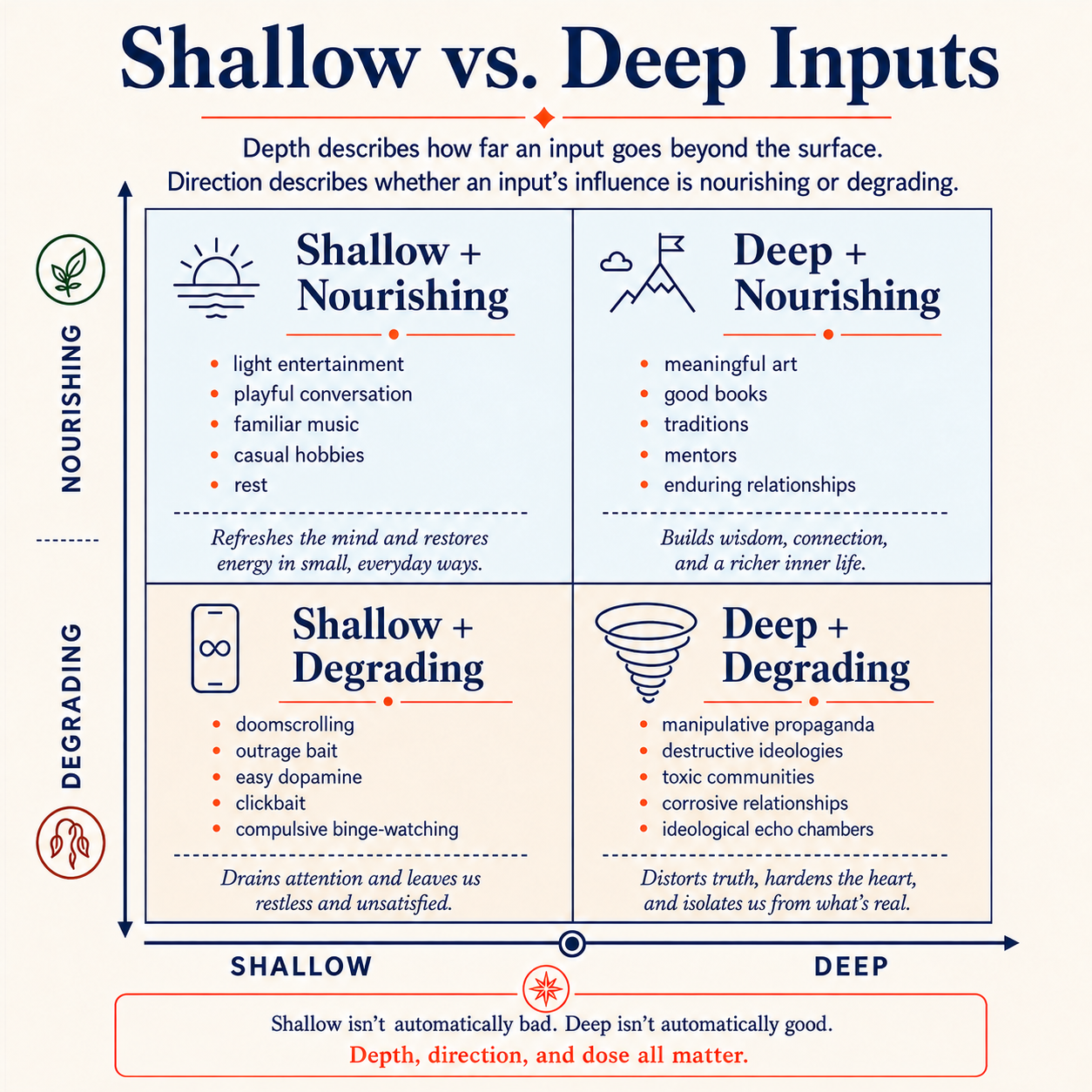
These aren’t rigid categories, but they do give a general sense of the landscape.
Shallow vs. Deep
Shallow inputs are those we engage with on a surface level, with little sustained reflection or deeper involvement. Everyday examples include light entertainment like watching TV, playful conversation, background music, social media scrolling, and casual hobbies.
Shallow inputs can refresh us or leave us distracted and drained. Their influence can accumulate through exposure and repetition, even when individual encounters are brief or easily forgotten. When the same attitudes keep appearing in our feeds, conversations, and entertainment, they can start to feel like common sense.
Shallow doesn’t automatically mean bad. What we’re exposed to, how often, and what it crowds out all matter.
Deep inputs are those we engage with beyond the surface, or that become woven into our identity and worldview. Everyday examples include books and formal education that shape how we think, long-term relationships, traditions passed down across generations, and communities that become central to our lives.
The same input can meet people at different depths. A movie can be light entertainment for one person and a childhood favorite tied to family traditions and personal history for another.
An input doesn’t have to be old to be deep, and depth doesn’t guarantee value. A deeply rooted belief isn’t necessarily true, and an enduring relationship isn’t necessarily healthy.
Nourishing vs. Degrading
Shallow vs. deep describes the depth of an input, but not whether it nourishes or degrades us.
A casual conversation can leave us laughing and feeling connected, or pull us into another round of gossip and complaints. A social media feed can help us unwind after a long day at work, or rile us up with a steady stream of drama and outrage.
The same is true of deeper inputs. A close-knit community can provide belonging and purpose, or promote harmful beliefs and demand unquestioning loyalty. A long-term relationship can encourage honesty and independence, or teach us to stay quiet and doubt our own judgment.
Nourishing doesn’t always mean pleasant. An honest conversation or a challenging book can make us uncomfortable while helping us grow. The question becomes: how is this input affecting us, both in the moment and over time?
Shaping the Mix
Different needs call for different inputs. We need room for light enjoyment alongside the relationships, traditions, and ideas that sustain us over time. There’s no ideal shallow-to-deep ratio that everyone should follow.
Dose matters, too. An hour of TV can help us unwind after a long day. But when one episode turns into a late-night binge that cuts into our sleep, the same activity starts costing more than it gives.
Our habits – including what we follow, the company we keep, and the environments we return to – can act as filters, shaping which inputs repeatedly reach us. Changing a social media feed or reaching out to a friend each week can shift that mix and gradually steer us in a different direction. Over time, these choices shape what becomes available and familiar.
Clarity helps us choose the right inputs at the right moments. With practice, we learn to recognize an input’s depth, evaluate whether it nourishes or degrades us, and notice when the overall mix is out of balance. What’s right depends on what we need and what our circumstances call for.
The Better Inputs framework helps us evaluate the influences in our lives, from the personal to the institutional, and shape the ecology of inputs we live within.
One question to ask yourself is, “What mix am I living in, and which inputs are steering me?”