
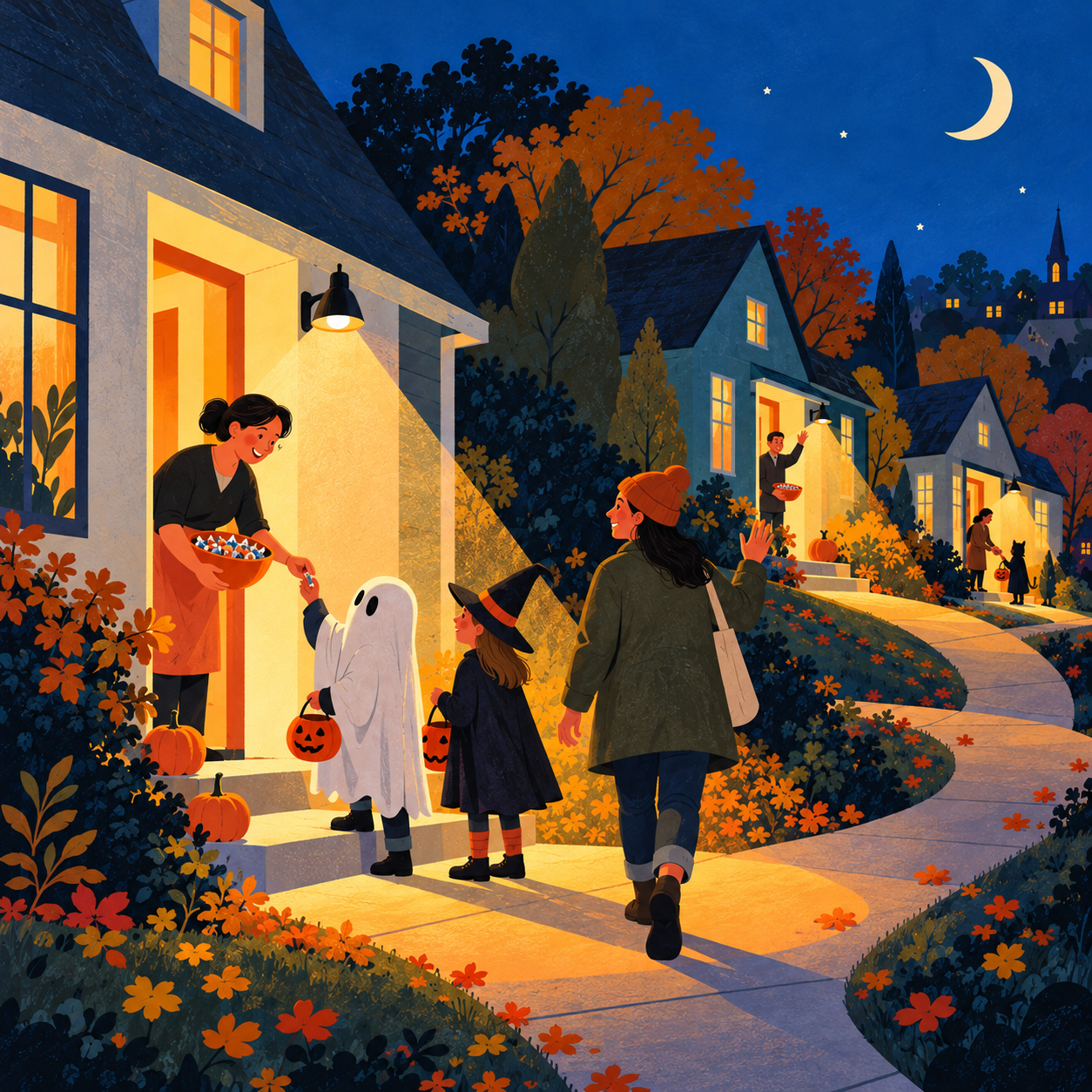
Trick-or-treating makes approaching an unfamiliar neighbor feel natural. Simple roles, visible signs of welcome, and brief exchanges help explain why this shared ritual endures.
Trick-or-treating has been a surprisingly resilient ritual in the face of declining communities and shared spaces.
According to National Retail Federation survey figures, 66% of Americans planning to celebrate Halloween in 2025 intended to hand out candy, compared to roughly 74% in 2005. That’s a small decline over twenty years, but still two-thirds of celebrants prepared to welcome trick-or-treaters.
Trick-or-treating has roots in European guising, a seasonal visiting tradition documented in Scotland since at least the 1500s. Participants visited homes in costume during celebrations such as Christmas and New Year. In its later Halloween form, children earned treats by singing songs or telling jokes.
Trick-or-treating began taking its modern form in Canada around the turn of the 20th century. A 1911 Ontario account describes children guising for nuts and candy. By 1917, newspapers were reporting children asking for food or money to ward off mischief, with calls of “tricks or treats” appearing in print for the first known time.
During the late 1940s and 1950s, trick-or-treating became a widespread American custom, and candy companies began promoting packaged sweets for the occasion. These gradually displaced homemade treats, a shift later reinforced by fears of tampering. Disney’s animated short Trick or Treat (1952) reflected the ritual’s growing place in American culture.
Why Trick-or-Treating Endures as a Social Ritual
Trick-or-treating provides an easy social script for neighbors to follow, which makes it especially inviting as a shared ritual. Knocking on an unfamiliar door can feel awkward on an ordinary evening. On Halloween, the purpose of the visit is already understood, and everyone has a simple role to play.
- An easy way to contribute. Children dress up, parents bring them house to house, and neighbors give out candy. Adults without children can join in simply by answering the door. Making children happy provides an immediate reward.
- Children help break the ice. Costumes invite comments and give neighbors an easy reason to ask children what they’re dressed as. Accompanying parents also get a natural opening to exchange greetings and join the conversation.
- Welcome is visible. Decorations, porch lights, and residents sitting outside signal participation. Seeing others involved makes joining feel easier.
- The calendar does the organizing. Everyone knows when it happens. Seasonal reminders give people plenty of time to buy costumes and candy. Familiarity and childhood memories help carry the tradition forward.
- Encounters are brief and manageable. The exchange has a clear beginning and endpoint, requires no existing friendship, and leaves room for conversation without demanding it.
All of these factors make Halloween and trick-or-treating a particularly strong community ritual. In one 1985 study published in Environment and Behavior, researchers found that decorating for Halloween and Christmas was associated with neighborhood attachment. Decorating also tended to cluster by block: when one household decorated, its neighbors often did too—a pattern consistent with social contagion.
This simple ritual has also been used to encourage civic action. Since 1950, Trick-or-Treat for UNICEF has encouraged children to collect donations alongside candy, turning familiar neighborhood visits into an opportunity to help children around the world. Trick-or-treating has also provided openings for voter outreach, giving civic groups and political campaigns an opportunity to share election information and meet residents.
Whether it raises money for children, encourages people to vote, or helps us recognize the family down the street, trick-or-treating gives people a familiar reason to come together. Keeping that invitation alive can be as simple as turning on the porch light and answering the door.