

Flow is a state of consciousness where action and awareness become one. It’s when a person is so fully immersed in an activity that they lose their sense of time and self. Mihaly Csikszentmihalyi calls it an “optimal state of experience.”
“Flow” is a concept in psychology first coined by Hungarian-American psychologist Mihaly Csikszentmihalyi in 1975.
Flow is defined as a state of consciousness where one is completely absorbed in an activity, along with a sense of energized focus, full involvement, and enjoyment, often to the point of losing one’s sense of time and self.
In everyday language, people use a variety of phrases to describe states of flow such as being “in the zone,” “on the ball,” “in a groove,” “on fire,” or “on one’s game.”
Common examples of flow include an athlete on a hot streak, an artist getting lost in a painting, or a chess master completely focused on their next move.
Mihaly Csikszentmihalyi’s famous book Flow: The Psychology of Optimal Experience is an excellent review of his decades of research studying flow in all types of people including athletes, chess masters, artists, rock climbers, swimmers, businessmen, industrial workers, and many more. Through in-depth interviews, questionnaires, and Experience Sampling Methods (having participants answer questions during random times of the day), Csikszentmihalyi identified the common characteristics of flow in a wide-range of activities.
Any activity can create a state of flow with the right mindset and approach.
But that’s often easier said than done. In this article, I’ll summarize the key components of flow and how you can begin cultivating it more in your daily life.
The Core Factors of Flow
To create flow, an activity has to meet certain conditions, including…
- Intrinsic motivation – Flow is more likely during activities that you enjoy doing for the sake of doing, not necessarily for external rewards like money, power, fame, or pleasure. Instead, activities are more likely to elicit flow if they provide internal rewards and purpose. Csikszentmihalyi calls these “autotelic activities,” which comes from the Greek word for “self-goal” or “self-end,” an activity that is an end in itself.
- A balance of challenge vs. skill – Activities that hit the “sweet spot” between challenge and difficulty vs. your current skill level are more likely to put you in flow. If something is too easy, you’ll get bored; but if something is too difficult, you’ll get frustrated – in both cases, you become less likely to maintain your focus and attention. I’ll elaborate more on this key component in the next section.
- Focus on a singular goal – Activities that create flow are often focused on a singular goal, blocking out all other concerns or distractions. When a baseball pitcher is pitching, they are focusing on nothing else but pitching well and winning the game – they aren’t thinking about what to eat for dinner or what movie to watch later. In flow, often nothing else matters except this one singular goal – all distractions are eliminated – that’s why it’s described as a state of hyper-focus.
- Immediate feedback – Since flow activities are goal-oriented, they have to have a way of providing immediate feedback or progress. A rock climber can see they are getting closer to their target, a chess master knows when they make a “good move” vs. a “bad move,” and an athlete knows how much they are winning or losing. While a person in flow isn’t doing the activity solely for this “feedback,” they require that benchmark to know if they are surpassing their present challenges and reaching closer to their goal. Having some way to measure progress adds a necessary element of direction and structure to the activity.
- Feeling the potential to succeed – In flow, a person always feels that they are being challenged, yet they believe they have the skills and determination to overcome those challenges. A person has to feel that they have the potential to succeed and they are always on the cusp of a major breakthrough or insight. This is what makes the experience so exhilarating, because the person feels they are stretching themselves to new limits and possibilities; even if a person “fails” at reaching their goal, the perception that they were close to success is enough to put them in that hyper-focused state.
Flow is a specific state of mind, it’s not just any altered state of consciousness. It’s a state of hyper focus where someone is “effortlessly” overcoming obstacles and challenges, so much that they become completely lost in the moment.
Like a talented jazz musician playing a solo, or a method actor completely committed to their role, or a basketball player that can’t even seem to miss a shot if they tried – they are completely lost in the moment, yet at the same time achieving to their fullest potential.
Passive activities such as watching TV, surfing social media, or drinking alcohol may give the appearance of being in a flow or “trance”-type state, but these activities often don’t share the same characteristics, because they usually aren’t challenging you or testing you. Instead of awakening your mind and energizing you, passive activities are more likely to “turn your mind off” or “zone out.”
Although it’s important to note that flow can look like “zoning out” to the outside world, such as a musician so lost in their instrument that they don’t realize someone entered the room, or someone calculating a difficult math problem and not hearing their friend call their name.
To be “in the zone” with one thing often means “zoning out” everything else. In a state of flow, the activity you’re doing becomes your entire world where nothing else matters. Action and awareness become one.
Can you think of any activities that match these characteristics and put you into a state of flow? Let’s learn more about how to actively find these “flow” states.
Challenge vs. Skill: Finding the Sweet Spot
One of the most important attributes of flow is finding the “sweet spot” between challenge and skill.
As mentioned before, an activity that is too easy will lead to boredom, while an activity that is too difficult will lead to anxiety.
This graph perfectly depicts how to maintain a flow state:
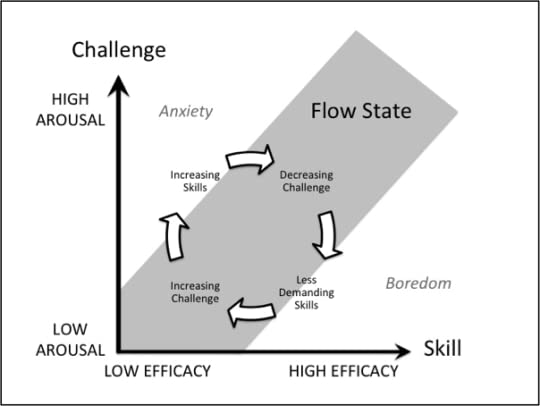
To maintain flow, you must be able to adjust the difficulty of an activity to fit your current skillset.
If an activity is too boring, then you can make it more difficult by adding new rules or setting your own goals.
One factory worker mentioned in Csikszentmihalyi’s book had a very tedious job on an assembly line, making the same movements over and over again. However he was able to find a “flow” state by keeping track of how fast he was moving (immediate feedback), and trying to beat his personal best record (goal-oriented). When asked to describe his job, he often saw himself as a type of “olympic athlete” who aimed for precision and perfection.
Another example is Joe the welder who declined a promotion as a foreman because he loved his job at a lower position. He was able to create “flow” by learning as much as he could about all the machines and being able to fix anything. While other welders often see their jobs as tedious and boring, Joe was able to continuously create new goals for himself, seeing every obstacle as a challenge, and finding new opportunities for learning and growth.
If an activity is too challenging, then you can make it less difficult by focusing on smaller goals.
Breaking down bigger goals into smaller and more realistic goals is one way to decrease the difficulty of a task and put you closer to flow.
Remember, it’s important to feel that a goal is within reach during flow. A tennis player who is just starting out may want to aim at smaller goals such as making contact with the ball, or just hitting it over the net, before challenging themselves to beat someone at a game.
One important thing to remember is that even activities where you have “low skills” or “zero skills” can still put you into a flow state if you set your goals at the appropriate level.
This is why someone who is losing at a game, or sucks at playing guitar, or has never played chess before can still find a flow state if they have the right approach. Perhaps even a simple goal like “let’s just see how much I can learn during my first time” is enough to heighten one’s attention and put them closer to flow.
As one learns new skills and improves themselves, they will have to continuously increase the challenges to keep themselves in a flow.
If a musician stops learning new songs and just plays what they already know, they will likely lose that sense of challenge, exploration, and boundary-pushing to keeps themselves fully engaged.
When trying to create flow during any activity, always keep this “challenge” vs. “skill” balance in mind.
Flow is an Important Ingredient to Happiness
Mihaly Csikszentmihalyi calls flow an “optimal state of experience,” and it’s become a popular concept in Positive Psychology over the last decade.
Flow is not only an “optimal experience” because it helps us to achieve great things in life or be more productive, but also because it leads to a happier and richer life overall.
Flow allows us to tap into our full potential and see ourselves performing at our best – it also gives our lives a greater sense of meaning and purpose.
While it’s difficult to always be in flow (if not impossible), having at least one daily activity that creates flow is important for building a sense of confidence, purpose, and achievement.
For many, activities related to “work” and “relationships” are the most common areas where flow is discovered, but other people can find flow in other things – even an intellectual or philosopher thinking about an interesting and perplexing theory can put themselves into a state of flow.
Whatever your “flow” activity may be, it’s important that you have one.